Bible Cartoon: Genesis 02 - Adam and Eve - Scene 03 - Eden's river branches
Click on Add to cart button below shopping cart.
Purchased Bible Cartoons do not have watermarks. Links to Cartoons provided on email once purchase is completed.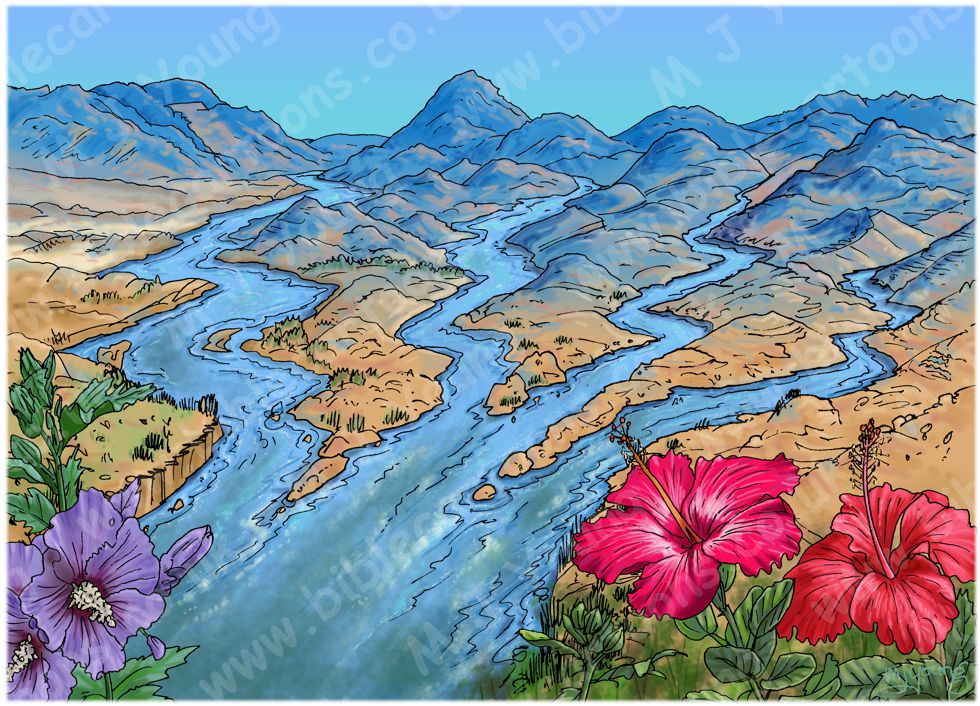


Bible Book: Genesis
Bible Book Code: 0100201001
Scene no: 3 of 6
Bible Reference & Cartoon Description
Genesis 2:10-14 (NLT)
10 A river watered the garden and then flowed out of Eden and divided into four branches. 11 The first branch, called the Pishon, flowed around the entire land of Havilah, where gold is found. 12 The gold of that land is exceptionally pure; aromatic resin and onyx stone are also found there. 13 The second branch, called the Gihon, flowed around the entire land of Cush. 14 The third branch, called the Tigris, flowed east of the land of Asshur. The fourth branch is called the Euphrates.
DRAWING NOTES:
TIME OF DAY:
Unspecified in the Bible narrative.
LIGHTING NOTES:
The sun (unseen above right) casts shadows to the left of objects.
CHARACTERS PRESENT:
None.
RESEARCH/ADDITIONAL NOTES:
According to Genesis 2:10–14, the Garden of Eden was the source of a single river that divided into four separate branches to water the earth: the Pishon, Gihon, Hiddekel (Tigris), and Phrath (Euphrates). In my picture the garden in Eden is behind the viewer, with the river branching in the foreground and leading off into the mountains.
Pishon: Described as encompassing the land of Havilah, known for gold and precious stones.
Gihon: Described as flowing around the entire land of Cush.
Hiddekel (Tigris): Identified as flowing east of Assyria.
Phrath (Euphrates): A well-known river, crucial to the ancient Near East and often simply called “the River”.
These rivers are generally understood to represent a, or, multiple major water sources in the region of ancient Mesopotamia.
In the foreground are Hibiscus flowers.
Havilah
Havilah is a biblical land known for its gold, bdellium, and onyx, mentioned in Genesis 2 as being watered by the Pishon River from Eden, but its exact location is uncertain, though generally thought to be in Arabia, possibly extending from the Persian Gulf to the Sinai Peninsula. It’s also linked to descendants of Cush and Joktan in Genesis 10 and 1 Chronicles, suggesting various locations, including areas near Mesopotamia or southern Arabia.
Cush
Cush (or Kush) was an ancient kingdom located in Nubia, primarily in present-day northern Sudan and southern Egypt, situated along the Nile Valley south of Egypt. It was a prominent civilization, often identified in the Bible with Ethiopia, and was a major power that ruled the region for centuries, including the 25th Dynasty of Egypt.
Assyria
Assyria was an ancient kingdom and empire located in northern Mesopotamia, primarily in modern-day northern Iraq, with parts extending into southeastern Turkey, northeastern Syria, and northwestern Iran. Centred around the Tigris River, its major cities included Ashur, Nineveh, and Nimrud.
Bible Doctrine Notes
2:10-14 HISTORY, Linear (3.31B)
The Holy Bible locates God’s actions within the sphere of the cosmos: time and space as we understand it. Human history is the arena of divine action starting with the first people: Adam and Eve. They did not lose a place in heaven and have to settle for a place on earth. Rather they were created from the dust of the earth, and meant to dwell here on earth. They did lose intimate relationship with God their creator, co-operation with each other and with the environment of the natural world, but God’s intention was always an earthly history with His creatures.