Bible Cartoon: John 03 - Jesus and Nicodemus - Scene 04 - For God so loved...
Click on Add to cart button below shopping cart.
Purchased Bible Cartoons do not have watermarks. Links to Cartoons provided on email once purchase is completed.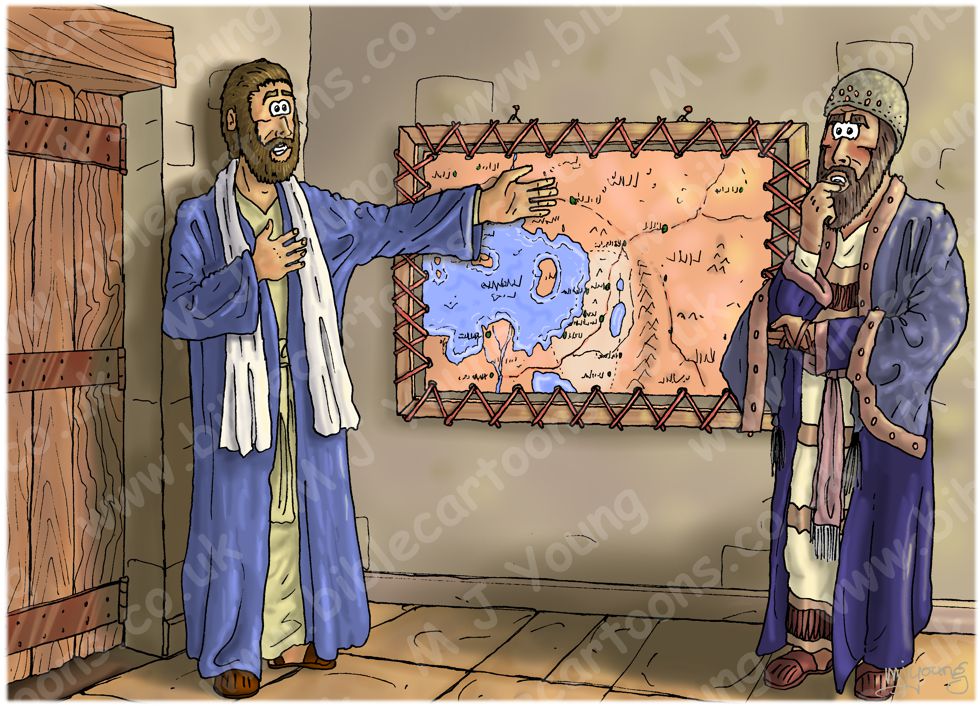


Bible Book: John
Bible Book Code: 4300301601
Scene no: 4 of 5
Bible Reference & Cartoon Description
John 3:16-18 (ANIV)
16 [Jesus said] “For God so loved the world that he gave his one and only Son, [1] that whoever believes in him shall not perish but have eternal life. 17 For God did not send his Son into the world to condemn the world, but to save the world through him. 18 Whoever believes in him is not condemned, but whoever does not believe stands condemned already because he has not believed in the name of God’s one and only Son.” [2]
[1]
Or, his only begotten Son.
[2]
Or, God’s only begotten Son.
DRAWING NOTES:
TIME OF DAY:
Verse 2 informs us this scene takes place at night.
LIGHTING NOTES:
There are no visible lamps in this scene, However, the previous scens show there are lamps in the house. Therefore
CHARACTERS PRESENT:
On the left is Jesus the Christ, on the right is the Pharisee Nicodemus.
RESEARCH/ADDITIONAL NOTES:
There are two versions of this scene:
The one above is “John 03 – Jesus and Nicodemus – Scene 04 – For God so loved….” This is the Bible Cartoon without the John 3:16 text across it.
The second version has the famous John 3:16 scripture, with that text across it. In fact you get 7 different versions of the scripture image!
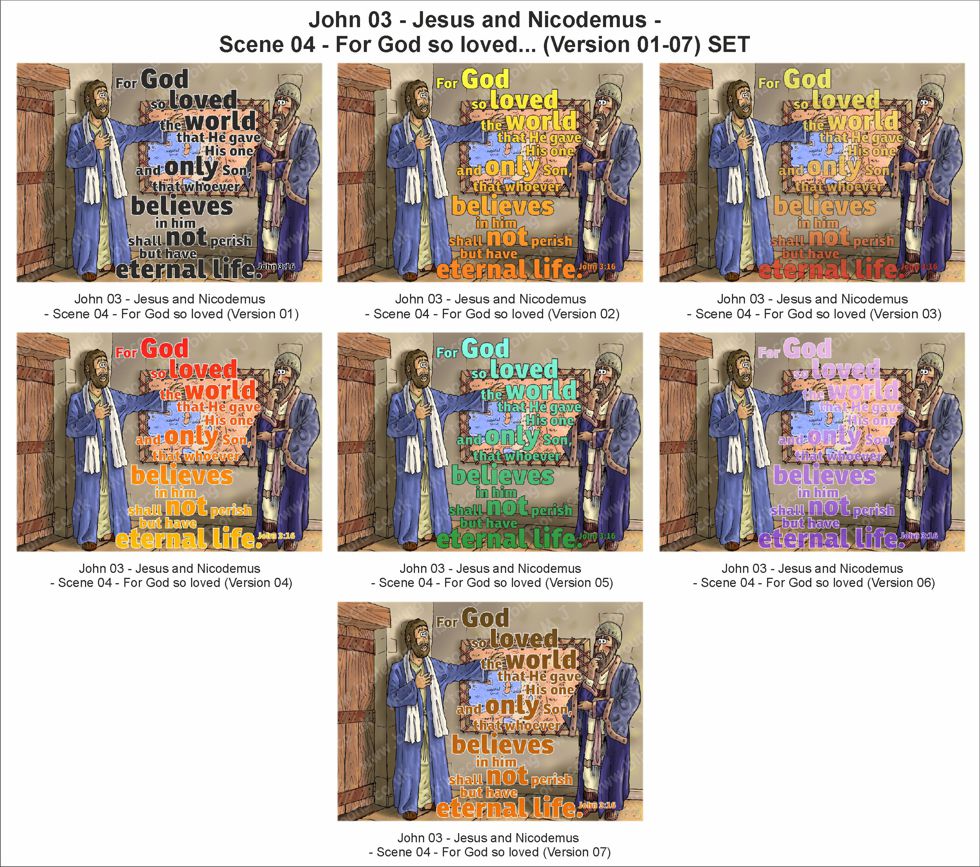
Click on the orange bar below to see/buy the same Bible Cartoon with the John 3:16 text applied across the image.
NOTE: If you purchase this Bible Cartoon you will receive ALL 7 variations of the Bible Cartoon, with the John 3:16 text on the top, in ALL 7 variations shown in the image.
Famous Bible Story – John 03v16 – For God so loved (Text Variations)In this scene, the two figures of Jesus and Nicodemus have moved to a wall by the front door, which has a map of the ancient world hung on it. Jesus is gesturing to himself (in reference to him being the Son of God) and to the map (in reference to the world). I know that it is very unlikely that anyone except a very rich scholar or king would have a map of any kind (such items being very expensive in the ancient world), but it was necessary to include it in this house, as a visual reference to “the world” in verse 16!
This picture illustrates probably one of the most well know verses in the whole of the Holy Bible. John 3:16 is often referred to as the “Gospel in a nutshell.” In this famous passage Jesus tells Nicodemus that God the Father’s love for the whole world is so deep and so great that He gave His only Son, Jesus Christ, as a sacrifice. Anyone who trusts and believes in Him will not face eternal destruction, but will receive the gift of everlasting life. Although this salvation is God’s desire, verse 18 makes it clear that whoever believes in Jesus will be saved to eternal life, but whoever rejects Jesus already stands condemned and is still lost in their unbelieving sin. The choice to accept Jesus or reject him is always ours.
Here’s the scene without the figures in the picture.
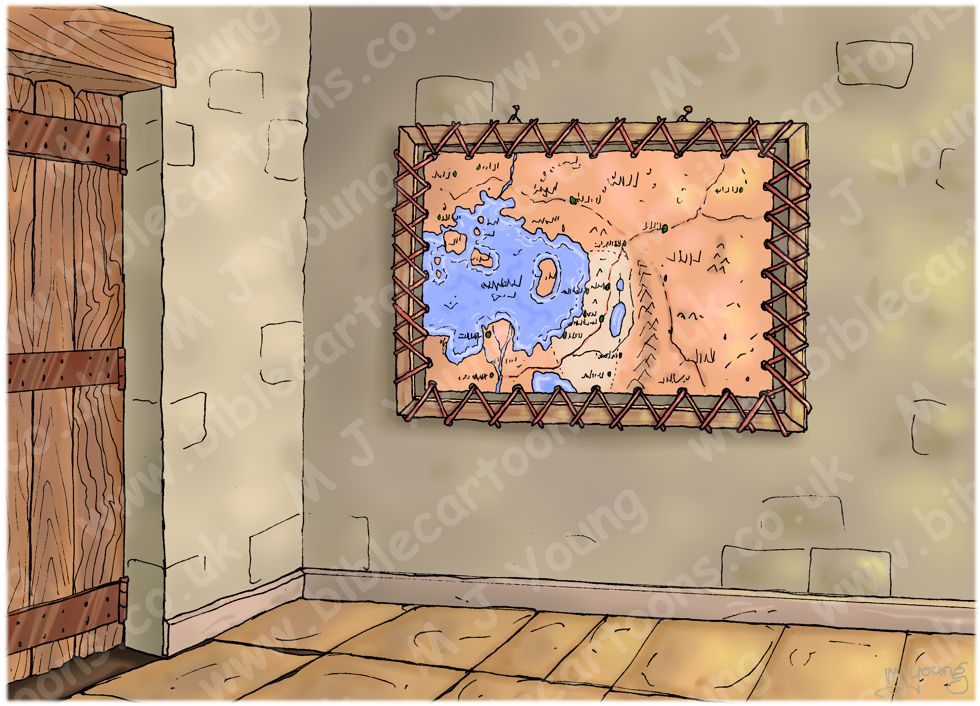
Background of John 03 – Jesus and Nicodemus – Scene 04 – For God so loved…
Click on the colour bar below to view/buy this Background:
Background of John 03 – Jesus and Nicodemus – Scene 04 – For God so loved…
In the original creation of this picture I had Nicodemus wearing a leather strap on his left hand (called a Phylactery). However, research has since shown me that these items are not worn after sunset, and Nicodemus visited Jesus at night, therefore I have removed the item from the figure in this picture. See notes in John 03 – Jesus and Nicodemus – Scene 01 – Night visit.
Bible Doctrine Notes
3:15-16,36 SALVATION, Eternal Life (4.26B)
Another term referring to eternal life is the kingdom of God and the new birth. It is a present possession as well as a future hope for all people who believe in Jesus, the Son of God. God loves the world, and the people in it, so much that He sent his Son to die on the cross to grant eternal life to those who entrust their lives to Him. God does not want anyone’s sin to destroy them and consign them to Hell, however those people who reject the Son are already living under Father God’s wrath. While people are still physically alive they need to believe and know Jesus, who grants eternal life.
3:16 GOD, Love (1.14A)
God the Father’s gift of His son Jesus the Christ, given freely to us as our Saviour, is the most profound demonstration and expression of God’s love for us. The Greek word agapao translated here as “love” is of special significance because it means a love that seeks to give itself away on behalf of its object. It is a love that seeks the very best interests and results for its object while seeking nothing for itself in return. It is important to notice that in verse 17 the priority of God’s purpose is to save over judgement or condemnation. For this very reason, God is declared to be love itself (see 1 John 4-8, 16). (See notes on Mark 1:11).
3:16-18 Jesus Christ, Son of God (1.22E)
(See note on 1:18). Jesus is God the Father’s gift of salvation to a needy world. His purpose is salvation, not condemnation. Jesus is the only path to full salvation.
3:17-18 SALVATION, Initiative (4.22B)
God loved the world so much that He was willing to send his only begotten Son, the only One of His kind, to save the world, rather than condemn it. The Greek word kosmos, translated here into “world” refers to that part of humankind which is in rebellion against God, as well the physical world; the whole universe.
3:18-21 SIN, Individual Choice (2.52B)
One aspect of Jesus (the light (John 8:12)) is to reveal us for what we are: either of God, or not. The Son of God demands that we either remain in the darkness of our unbelief, or else we believe in Him and come into the light. There is no middle, neutral position that can be taken: Jesus confronts us with only these two choices. We refuse to believe because our depraved lifestyles prefer sin to Jesus. This depravity comes because we choose evil deeds; the consequence is guilt and fear of God. We know our wickedness becomes evident in the presence of Jesus’ purity. Despite this, we are not beyond hope; since Jesus came to save sinners like us.