Bible Cartoon: Judges 06 - Gideon - Scene 02 - Hordes like locusts
Click on Add to cart button below shopping cart.
Purchased Bible Cartoons do not have watermarks. Links to Cartoons provided on email once purchase is completed.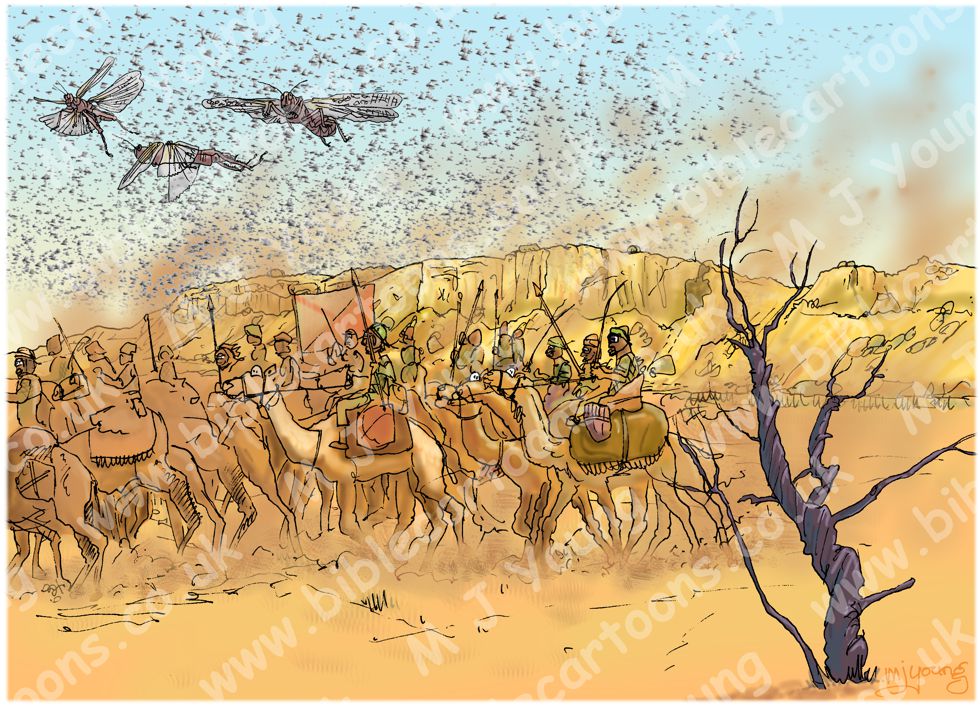


Bible Book: Judges
Bible Book Code: 0700600301
Scene no: 2 of 13
Bible Reference & Cartoon Description
Judges 6:3-5 (NLT)
3 Whenever the Israelites planted their crops, marauders from Midian, Amalek, and the people of the east would attack Israel, 4 camping in the land and destroying crops as far away as Gaza. They left the Israelites with nothing to eat, taking all the sheep, goats, cattle, and donkeys. 5 These enemy hordes, coming with their livestock and tents, were as thick as locusts; they arrived on droves of camels too numerous to count. And they stayed until the land was stripped bare.
DRAWING NOTES:
TIME OF DAY:
Unspecified in Bible narrative. I have set this scene in the early afternoon.
LIGHTING NOTES:
The sun (unseen, high in the West (left)) illuminates this scene, casting shadows below and to the right of figures and objects.
CHARACTERS PRESENT:
Midianites, Amalekites, and the people of the east.
RESEARCH/ADDITIONAL NOTES:
This scene shows the Midianites, Amalekites, and the people of the east, riding camels across the fertile fields of the Jezreel valley in Israel.
Here’s the scene without the hordes.
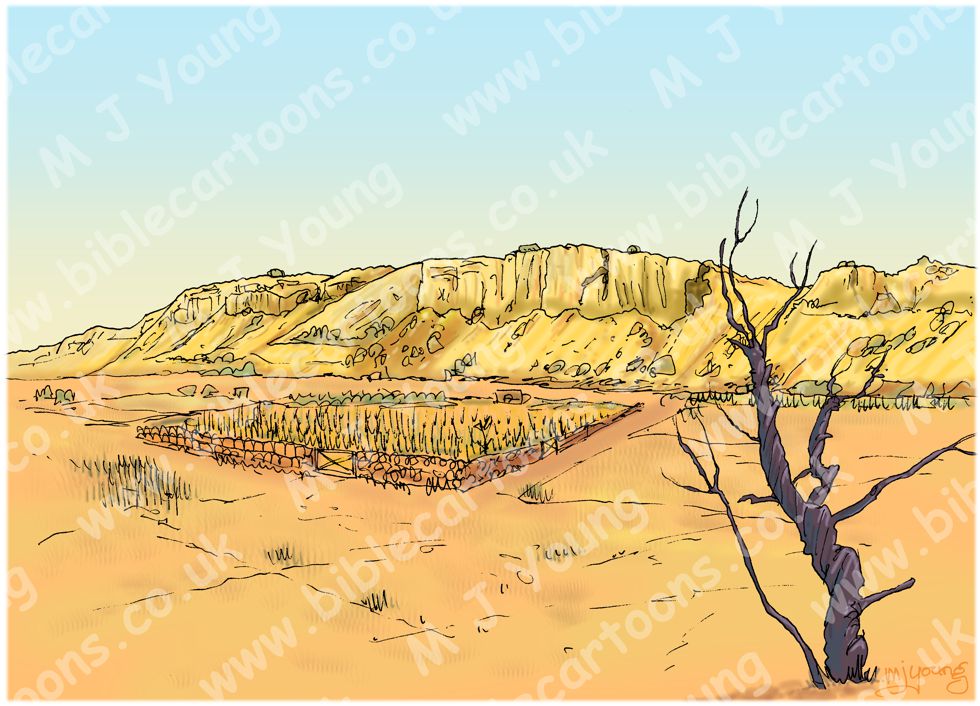
Background of Judges 06 – Gideon – Scene 02 – Hordes like locusts
Click on the colour bar below to view/buy this Background:
Background of Judges 06 – Gideon – Scene 02 – Hordes like locusts
A note about the locusts.
Locusts (derived from the Latin locusta, locust or lobster) are various species of short-horned grasshoppers in the family Acrididae that have a swarming phase. These insects are usually solitary, but under certain circumstances they become more abundant and change their behaviour and habits, becoming gregarious.
The particular locust I have drawn is the desert locust.
“Schistocerca gregaria (The desert locust) is a species of locust in the grasshopper family, Acrididae. A periodically swarming, short-horned bird grasshopper, it is found primarily in the deserts and dry areas of northern and eastern Africa, Arabia, and southwest Asia. During population surge years, its range may extend north into parts of Southern Europe, Eastern Africa, and Northern India. The desert locust shows periodic changes in its body form and can change in response to environmental conditions over several generations. It begins life as a solitary, shorter-winged, highly fecund (producing enormous amounts of offspring), non-migratory form, to a gregarious, long-winged, and migratory phase in which it may travel long distances into new areas. Due to this traveling, it may join groups, thus, forming locust plagues. This involves invading new areas where it may consume all vegetation including valuable crops. Although at other times, it may live unnoticed in small numbers in various areas.
The desert locust is a species of orthopteran in the family Acrididae, subfamily Cyrtacanthacridinae. There are two subspecies, one called Schistocerca gregaria gregaria, the better known and of huge economic importance, located north of the equator, and the other, Schistocerca gregaria flaviventris, which has a smaller range in south-west Africa and is of less economic importance, although outbreaks have been observed in the past.
Solitary Females are 6–9 cm long; Solitary males are 4.5–6 cm; gregarious female 5–6 cm long; gregarious males 4.5–5 cm. The prosternal tubercle is straight, blunt and slightly sloping backwards. The Male subgenitial plate is biloped, ceri, flat and blunt. Elytra are marked with large irregular spots, and the pronotum is not crested, and is narrower and saddle-shaped in the gregarious phase. The eyes are striated, and the number of striae increases after each moult and are only clearly visible in solitary individuals.”
[Source: https://en.wikipedia.org/wiki/Desert_locust]