Bible Cartoon: Matthew 13 - Parable of the mustard seed - Scene 01 - Tiny seeds
Click on Add to cart button below shopping cart.
Purchased Bible Cartoons do not have watermarks. Links to Cartoons provided on email once purchase is completed.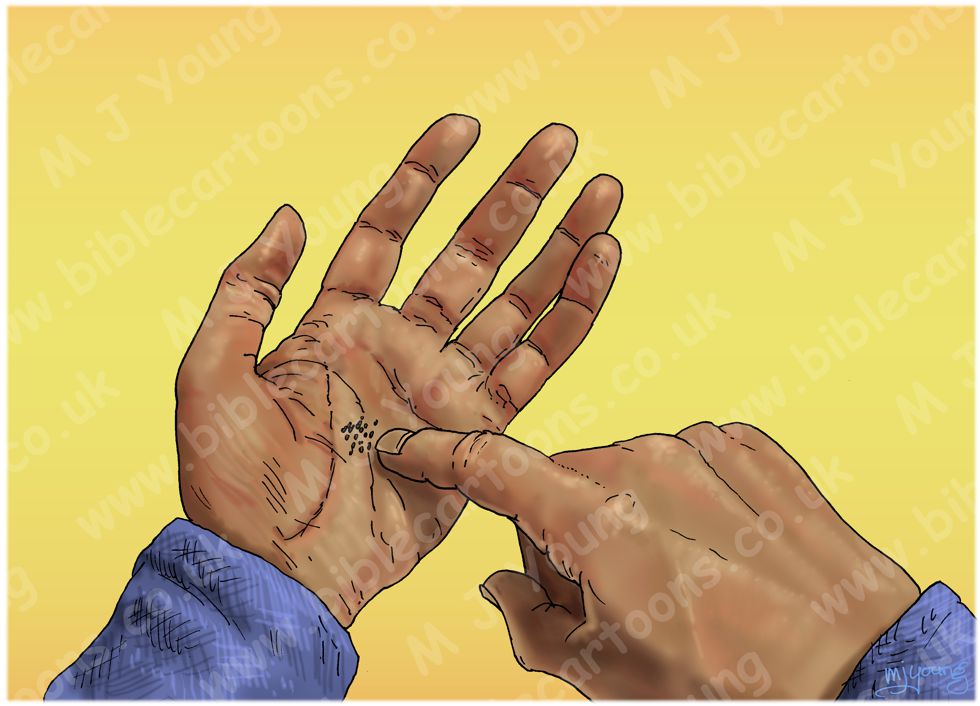


Bible Book: Matthew
Bible Book Code: 4001303101
Scene no: 1 of 2
Bible Reference & Cartoon Description
Matthew 13:31-32a (NLT)
31 Here is another illustration Jesus used: “The Kingdom of Heaven is like a mustard seed planted in a field. 32a It is the smallest of all seeds,… [but it becomes the largest of garden plants; it grows into a tree, and birds come and make nests in its branches.”]
DRAWING NOTES:
TIME OF DAY:
Unspecified in the Bible narrative. Daytime.
LIGHTING NOTES:
CHARACTERS PRESENT:
Jesus.
RESEARCH/ADDITIONAL NOTES:
This simple picture shows Jesus pointing at the tiny mustard seeds in his hand.
“The Kingdom of heaven is like a mustard seed… but when it is grown, it is greater than the herbs and becomes a tree” (Matthew 13:31-32)
You know this parable. But do you know what Jesus was really saying? Most translations miss the profound Hebrew wordplay that would have made Jesus’s audience gasp. When He said “mustard seed,” He wasn’t just talking about size.
The Hebrew word for “small” (katan) doesn’t just mean tiny. It often implies something insignificant or despised. When Scripture speaks of something becoming “great” (gadol), it frequently describes God’s miraculous intervention.
This is God’s pattern throughout Scripture. He chooses the katan (small, despised) to accomplish the gadol (great, mighty). Think of David versus Goliath, or God choosing Israel as the smallest of nations.
And this same katan to gadol pattern echoes through every promise in Scripture, from God’s shalom that transforms brokenness into wholeness, to His chesed (lovingkindness) that turns rejection into covenant love.”
[Source: IsraelBibleCenter.com]
The mustard plant is any one of several plant species in the genera Brassica, Rhamphospermum and Sinapis in the family Brassicaceae (the mustard family).
While a mustard plant is an actual herbaceous annual herb (like Brassica) growing 2-10 ft tall with soft stems and yellow flowers, dying after seeding, there is no true “mustard tree” as described in this parable. The “tree” concept refers to large, bushy mustard-like plants (like Salvadora or Nicotiana glauca) that develop woody parts and live longer but aren’t botanically Brassica mustards.
The mustard Plant is an herbaceous annual (only lives one season), with green, soft, non-woody stems. The plant typically reaches a height of 2-10 feet (0.6-3 metres) (up to 30 ft (9.1 metres) in perfect conditions). It has distinctive four-petaled yellow flowers, pungent leaves and grows from a single taproot. Mustard is grown for leaves (salads) or seeds (spice).
The “Mustard Tree” possibly refers to plants that look tree-like or grow tall, but are not a woody Brassica tree.
Salvadora persica (Toothbrush Tree) or Nicotiana glauca (Tree Tobacco) are sometimes called the mustard tree. Unlike the true herbaceous mustard plant, these plants do develop woody trunks and branches. The main distinction is botanical classification and structure; whilst mustard plants are soft-stemmed herbs, the plants called “mustard trees” are different species, with woody growth.
Bible Doctrine Notes
13:31-32 THE CHURCH, God’s Kingdom (5.13A)
Worldly success standards do not apply to the kingdom of God; it grows as God choses and sees fit. In spite of apparent small, humble beginnings, the kingdom of God grows to enormous significance. See note of Matthew 13:24-30.