Bible Cartoon: Matthew 13 - Parable of the weeds - Scene 04 - Harvest separation
Click on Add to cart button below shopping cart.
Purchased Bible Cartoons do not have watermarks. Links to Cartoons provided on email once purchase is completed.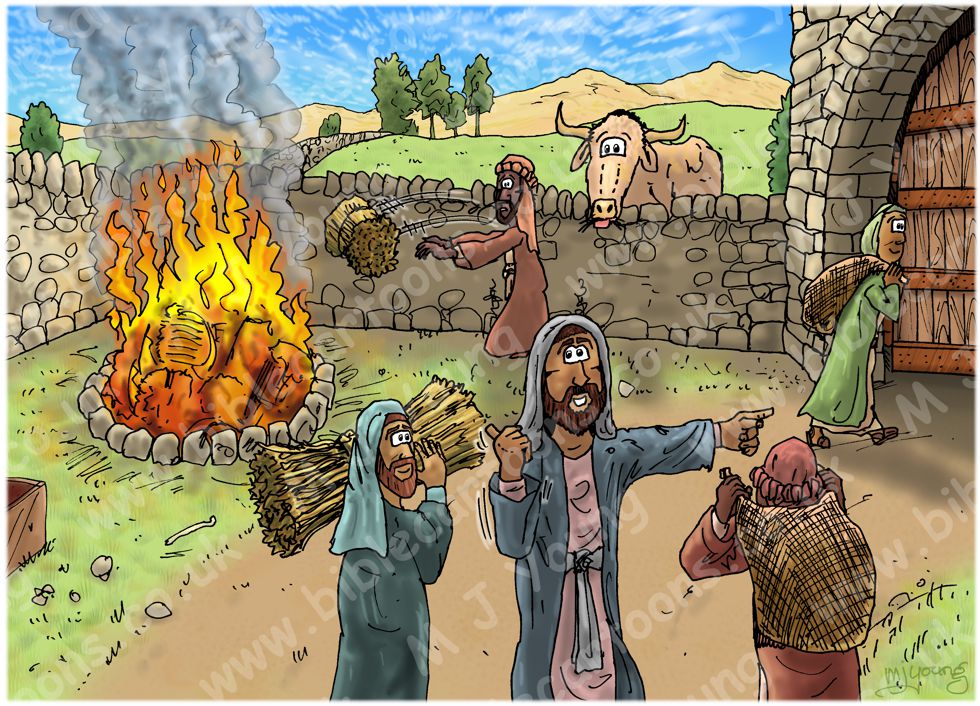


Bible Book: Matthew
Bible Book Code: 4001302801
Scene no: 4 of 4
Bible Reference & Cartoon Description
Matthew 13:28-29 (NLT)
28 [Jesus continue telling his parable] “‘An enemy has done this!’ the farmer exclaimed.
“‘Should we pull out the weeds?’ they asked.
29 “‘No,’ he replied, ‘you’ll uproot the wheat if you do. 30 Let both grow together until the harvest. Then I will tell the harvesters to sort out the weeds, tie them into bundles, and burn them, and to put the wheat in the barn.’”
DRAWING NOTES:
TIME OF DAY:
Unspecified in Bible narrative, I have set this scene in the late morning.
LIGHTING NOTES:
The sun (high in the sky on the left (West) illuminates this scene, casting shadows to the right and below figures and objects.
CHARACTERS PRESENT:
From left to right: Two servants carrying weed bundles to be burnt in the bonfire, the farmer (in grey/blue outer robe), 2 more servants carrying grain sacks into the barn.
RESEARCH/ADDITIONAL NOTES:
This scene shows the outcome of Jesus’ parable, the separation of the weeds from the wheat during the harvest. The weeds are bundled up & thrown into the bonfire, while the wheat grain is stored in hessian sacks in the farmers barn.
Here’s the scene without the figures or cow in the foreground.
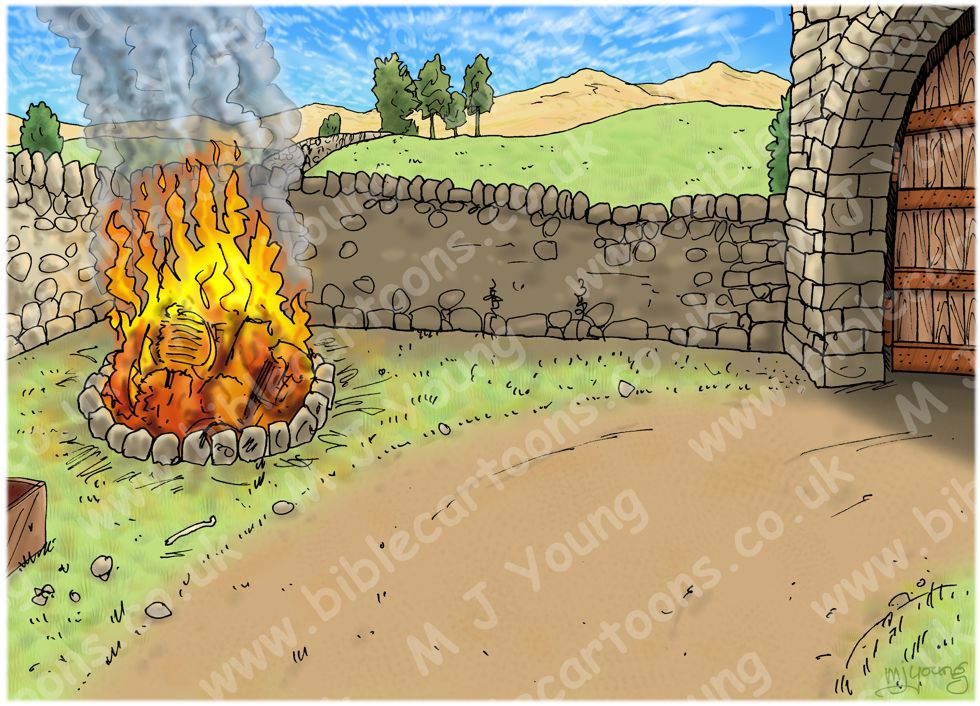
Background of Matthew 13 – Parable of the weeds – Scene 04 – Harvest separation
Click on the colour bar below to view/buy this Background:
Background of Matthew 13 – Parable of the weeds – Scene 04 – Harvest separation
Since “tares” (specifically Lolium temulentum (aka Darnel)) are toxic and closely resemble wheat until maturity, this similarity explains why the farmer in Jesus’s parable told his servants to leave the tares alone, until harvest time. Additionally the farmer was concerned that the wheat may be accidentally uprooted with the weeds. At harvest time it would be much easier for the harvesters to differentiate between the good wheat and the useless tares, setting bundles of the latter aside to be burnt. This is a graphic representation of what will happen to anyone rejecting the message of salvation brought by Jesus; such people are the weeds in his parable, and their fate is to be burnt up in the lake of eternal fire in Hades/Hell. The people who accept the Good News of the Gospel of Jesus are the equivalent of the wheat grain, stored in the farmers barn, i.e. people go to be with Jesus, their Lord and Saviour.
Bible Doctrine Notes
1:1 THE CHURCH, God’s Kingdom (5.13A)
Jesus spoke in parables to describe the kingdom of God. Although the kingdom is not a man planting seeds, yet it can be compared (to allow for human understanding) to such mundane events. This particular parable describes the current and future aspects of God’s kingdom. The seeds scattered by the farmer, and now growing, refer to the present situation of God’s kingdom, whilst the harvest relates to the future development of the kingdom. At that critical time, the true nature and character of everyone will be revealed, and judged. In the mean time, the church represents God’s kingdom here on earth; not as a separate, isolated group of people, but mixed up in a world full of evil people, themselves influenced and directed by Satan.