Bible Cartoon: Nehemiah 12 - Dedication of the wall of Jerusalem - Scene 02 - First choir
Click on Add to cart button below shopping cart.
Purchased Bible Cartoons do not have watermarks. Links to Cartoons provided on email once purchase is completed.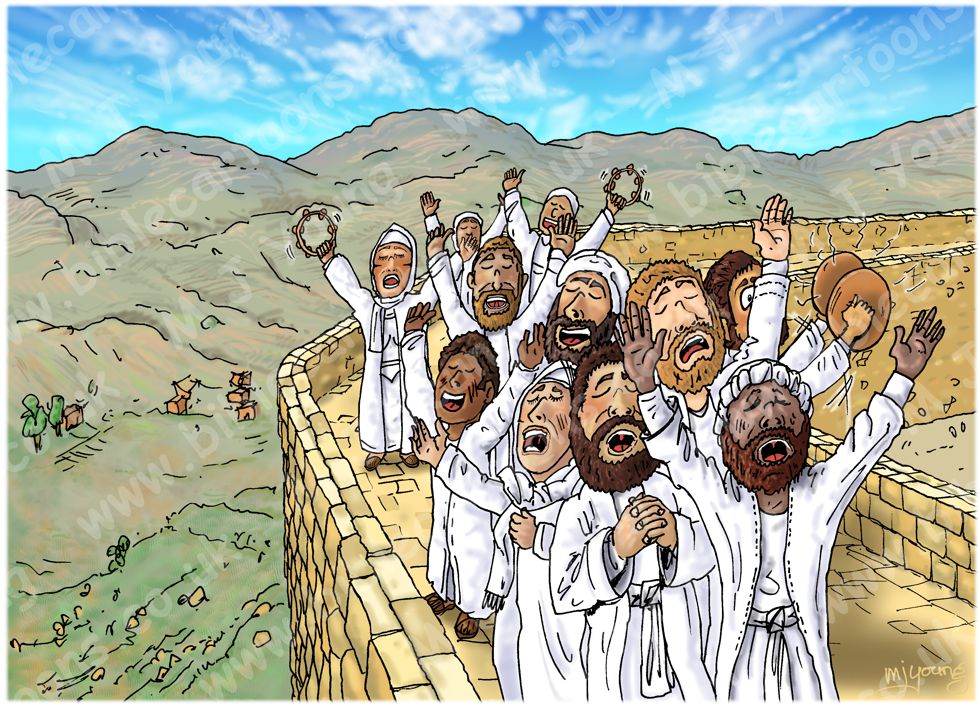



Bible Book: 2 Kings
Bible Book Code: 1601203101
Scene no: 1 of 1
Bible Reference & Cartoon Description
Nehemiah 12:31-37 (ANIV)
31 I had the leaders of Judah go up on top [1] of the wall. I also assigned two large choirs to give thanks. One was to proceed on top [2] of the wall to the right, towards the Dung Gate. 32 Hoshaiah and half the leaders of Judah followed them, 33 along with Azariah, Ezra, Meshullam, 34 Judah, Benjamin, Shemaiah, Jeremiah, 35 as well as some priests with trumpets, and also Zechariah son of Jonathan, the son of Shemaiah, the son of Mattaniah, the son of Micaiah, the son of Zaccur, the son of Asaph, 36 and his associates—Shemaiah, Azarel, Milalai, Gilalai, Maai, Nethanel, Judah and Hanani—with musical instruments prescribed by David the man of God. Ezra the scribe led the procession. 37 At the Fountain Gate they continued directly up the steps of the City of David on the ascent to the wall and passed above the house of David to the Water Gate on the east.
[1]
Or, go alongside…
[2]
Or, proceed alongside…
DRAWING NOTES:
TIME OF DAY:
Unspecified in Bible narrative. Daytime.
LIGHTING NOTES:
The unseen sun (high in the sky to the left) illuminates this scene, casting strong shadows below & to the right of figures & objects.
CHARACTERS PRESENT:
One of the choirs.
RESEARCH/ADDITIONAL NOTES:
This scene shows one of the choirs organised by Nehemiah on top of the walls of Jeruslaem. We can see the countryside around the city below.
Here is the scene without the figures on the wall in the foreground.
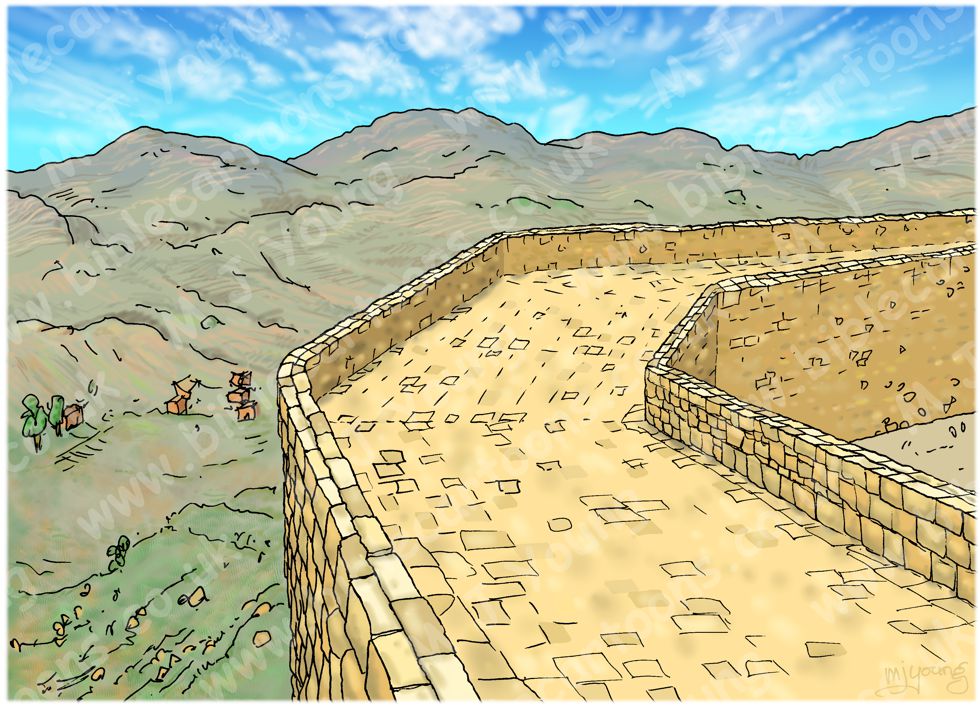
Bible Cartoon: Nehemiah 12 – Dedication of the wall of Jerusalem – Scene 02 – First choir – Background
Click on the colour bar below to view/buy this Background:
Bible Cartoon: Nehemiah 12 – Dedication of the wall of Jerusalem – Scene 02 – First choir
Notice that I have women as well as men in the choir on the wall. At the time of Nehemiah, formal liturgical singers (musicians and choir members) associated with the Temple were primarily men, specifically Levites. However, the historical listings (e.g. Ezra 2:65 and Nehemiah 7:67) mention “singing men and singing women” (meshorerim and meshorerot) among the Hebrew community returning from exile in Babylon.
While the formal singing and instrument-playing in the choir procession on the wall were led by appointed men and Levites, when the choirs went into the house of God (the 2nd Temple), they were joined by women and children, who actively participated in the overarching joy, celebration, and vocal praise. As Nehemiah 12:43 (NIV) clearly states, “The women and children also rejoiced. The sound of rejoicing in Jerusalem could be heard far away”.
A note about Levite clothing.
During the time of Nehemiah (the Post-Exilic/Persian period, c. 5th century B.C.), the Levites and temple choir members wore garments made of fine white linen. While the book of Nehemiah itself does not explicitly focus on the fabric details of their clothing, it emphasizes rigorous ritual purification and the restoration of temple orders. Before executing their historic march in two massive choral processions atop the city walls, the text notes, in Nehemiah 12:30, that the priests and Levites purified themselves, the people, the gates, and the wall. Part of this ritual purification involved washing their clothes to ensure they stood before God in immaculate, untainted white garments. Indeed, the defining characteristic of the Levitical choir and temple servants was their uniform fabric. Their attire was strictly unadorned, uniform white linen to maintain a collective focus on the corporate worship and the glory of God rather than individual (human) prestige.
Parallel texts in Chronicles—written during the same Second Temple era—and historical records provide the specific details of what these ritual singers and assistants wore.
Fine White Linen (Bû?): Unlike the everyday wool garments worn by common citizens, the Levites serving in the temple choirs wore robes of fine white linen. 2 Chronicles 5:12 explicitly describes the Levitical singers (Asaph, Heman, Jeduthun, and their choirs) as being “arrayed in fine linen.”
The Tunic (Ketonet): The base layer was a full-length, long-sleeved tunic woven as a single piece without seams. White symbolized purity, light, and a state of holiness separate from ordinary life.
The Sash (Anet): The long linen tunic was bound at the waist by a woven sash.
Head Covering (Migba’ah or Turban): While the High Priest wore an elaborate miter, regular officiating Levites and priests wore simpler, functional linen turbans or caps.
Bible Doctrine Notes
12:27-43 PRAYER, Worship (5.55A)
The dedication of the newly repaired walls of Jerusalem was characterised by elaborate ceremony involving priests, Levites and the Hebrew people. The dedication of the second Temple involved elaborate sacrifice and mainly involved priests and Levites (Ezra 6:16-17). Notice that the division of the Levites into two choirs that walked around the tops of the walls in opposite directions is quite unusual. The completion of the repairs to Jerusalem’s defensive walls was a very special occasion that rightly required thanksgiving to the God who inspired the collaborative work. See note on 11:17.