Bible Cartoon: Nehemiah 04 - Opposition to the building - Scene 07 - Nehemiah directs the defenders
Click on Add to cart button below shopping cart.
Purchased Bible Cartoons do not have watermarks. Links to Cartoons provided on email once purchase is completed.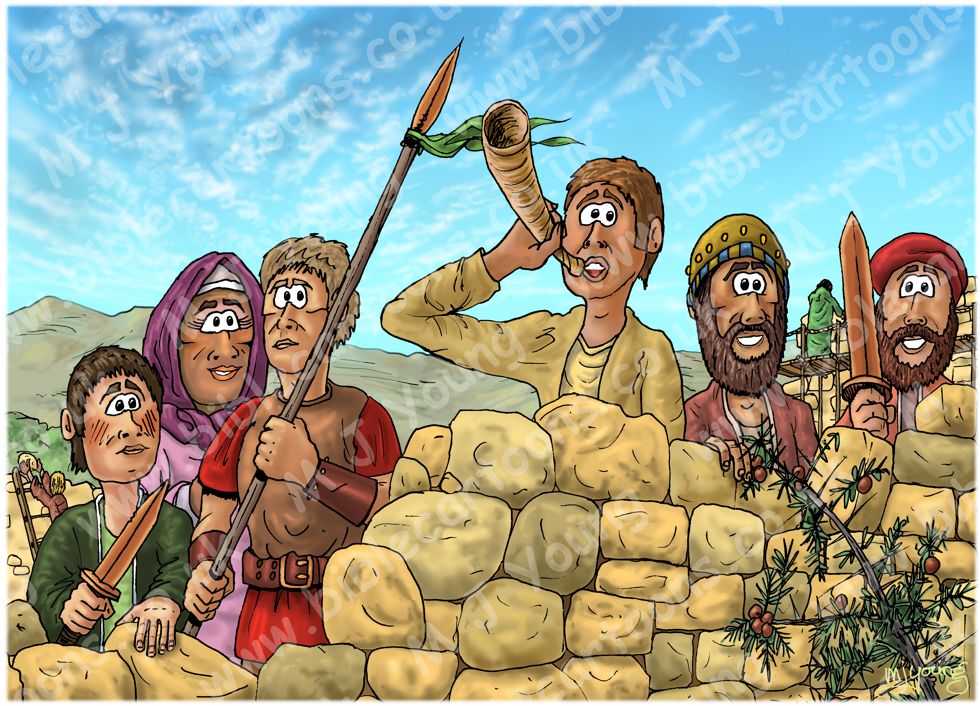


Bible Book: Nehemiah
Bible Book Code: 1600401901
Scene no: 2 of 2
Bible Reference & Cartoon Description
Nehemiah 4:19-23 (ANIV)
19 Then I said to the nobles, the officials and the rest of the people, “The work is extensive and spread out, and we are widely separated from each other along the wall. 20 Wherever you hear the sound of the trumpet, join us there. Our God will fight for us!”
21 So we continued the work with half the men holding spears, from the first light of dawn till the stars came out. 22 At that time I also said to the people, “Have every man and his helper stay inside Jerusalem at night, so that they can serve us as guards by night and workmen by day.” 23 Neither I nor my brothers nor my men nor the guards with me took off our clothes; each had his weapon, even when he went for water. [1]
[1]
The meaning of the Hebrew of this clause is uncertain.
DRAWING NOTES:
TIME OF DAY:
Day time.
LIGHTING NOTES:
The unseen sun (above left) illuminates this scene, casting shadows below & to the right of figures and objects.
CHARACTERS PRESENT:
Nehemiah is the man second from the right. The other figures are various Hebrew people, working on building the walls of Jerusalem.
RESEARCH/ADDITIONAL NOTES:
This scene shows Nehemiah directing the Hebrew people who are helping to build up Jerusalem’s walls.
Here is the scene without the figures in the foreground.
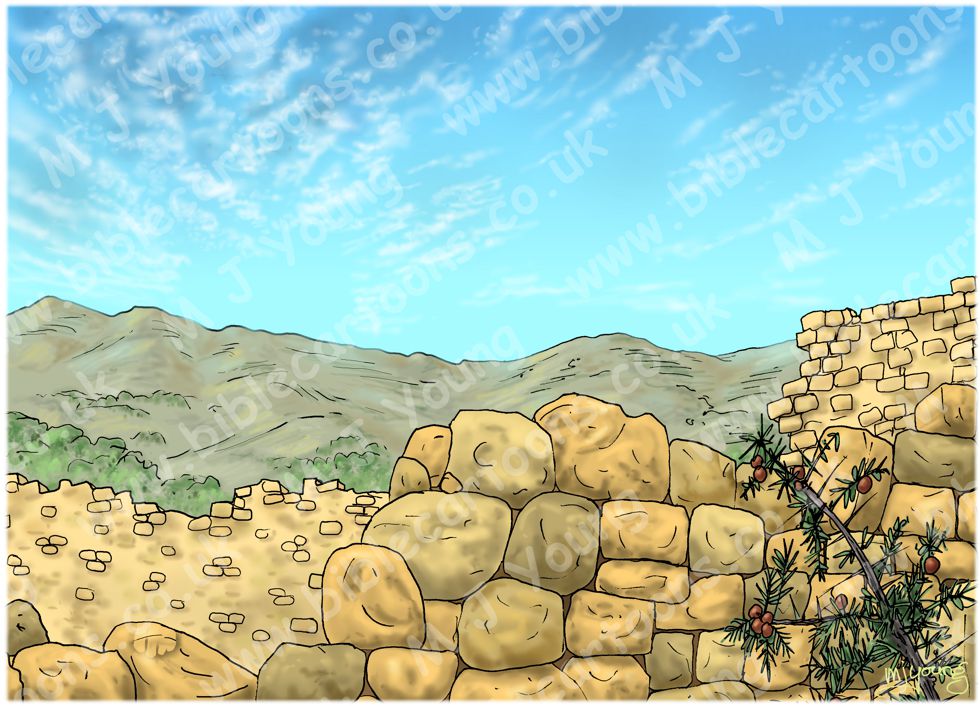
Bible Cartoon: Nehemiah 04 – Opposition to the building – Scene 07 – Nehemiah directs the defenders – Background
Click on the colour bar below to view/buy this Background:
Bible Cartoon: Nehemiah 04 – Opposition to the building – Scene 07 – Nehemiah directs the defenders
The prickly plant in the foreground is Juniperus deltoides (syn. Juniperus oxycedrus subsp. deltoides), aka the Eastern prickly juniper, which is a species of juniper native to the eastern Mediterranean. Although it is sometimes considered a subspecies of Juniperus oxycedrus, phylogenetic studies have found the two are not closely related.
[Source: https://en.wikipedia.org/wiki/Juniperus_deltoides]
Juniperus deltoides (commonly known as eastern prickly juniper) is an evergreen, dioecious (having male and female reproductive structures on separate plants) shrub or small tree in the cypress family (Cupressaceae).
The plant reaches up to 39 feet (12 metres) tall, often featuring a pyramidal crown with erect branches, or a lower shrub habit. The leaves are needle-like, measuring 0.35-0.66 inches (9–17 mm) long and 0.059-0.094 inches (1.5–2.4 mm) wide, with a broad-concave adaxial surface and two glaucous (waxy-blue) stomatal bands. Unlike Juniperus oxycedrus, the leaf base only tapers in the distal (upper) portion rather than narrowing all the way to the base. The bark of Juniperus deltoides is Cinnamon-brown to greyish-brown in colour & exfoliates in thin plates. The cones (berries) are globose seed cones that ripen in their second year, shifting from green to dark red or reddish-brown with a glaucous bloom. The tips of the cone scales are typically visible and protrude slightly.