Bible Cartoon: Nehemiah 02 - Nehemiah inspects Jerusalem's walls - Scene 05 - Plans revealed
Click on Add to cart button below shopping cart.
Purchased Bible Cartoons do not have watermarks. Links to Cartoons provided on email once purchase is completed.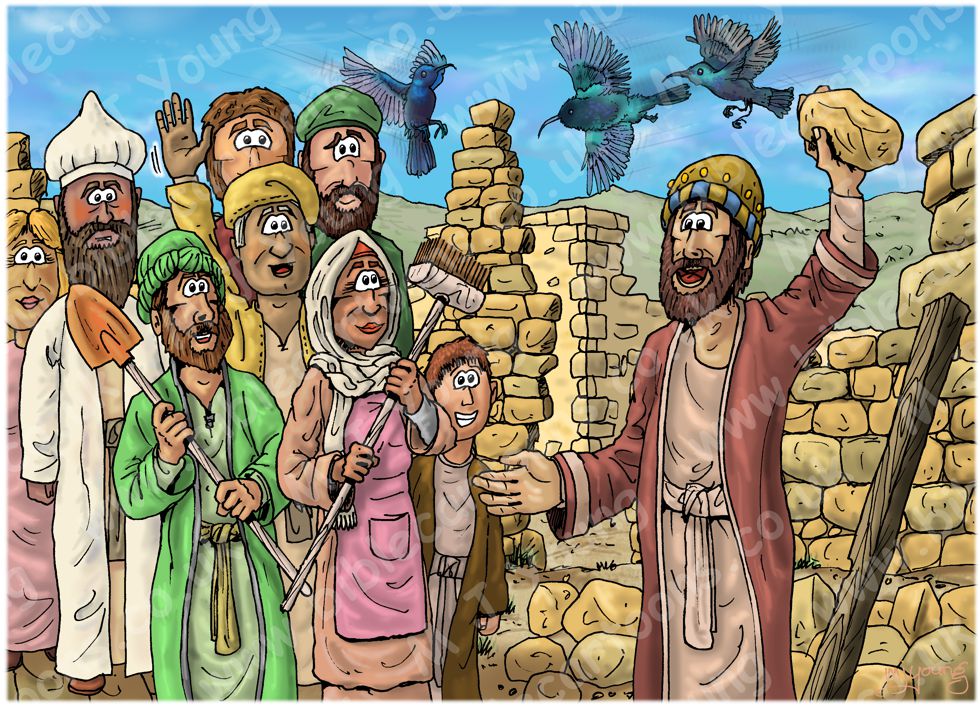


Bible Book: Nehemiah
Bible Book Code: 1600201601
Scene no: 5 of 6
Bible Reference & Cartoon Description
Nehemiah 2:16-18 (ANIV)
16 The officials did not know where I had gone or what I was doing, because as yet I had said nothing to the Jews or the priests or nobles or officials or any others who would be doing the work.
17 Then I said to them, “You see the trouble we are in: Jerusalem lies in ruins, and its gates have been burned with fire. Come, let us rebuild the wall of Jerusalem, and we will no longer be in disgrace.” 18 I also told them about the gracious hand of my God upon me and what the king had said to me.
They replied, “Let us start rebuilding.” So they began this good work.
DRAWING NOTES:
TIME OF DAY:
Day time.
LIGHTING NOTES:
The sun (unseen above left) illuminates this scene, casting shadows below and to the right of figures and objects.
CHARACTERS PRESENT:
On the left is a crowd of “the Jews, priests, nobles, officials or any others who would be doing the work” (see verse 16 above). On the right, holding a stone up is Nehemiah son of Hacaliah.
RESEARCH/ADDITIONAL NOTES:
This scene shows Nehemiah standing amidst the ruined walls and buildings of Jerusalem, talking to a group of people. He is telling them about the walls and gates of Jerusalem, and urging them to rebuild.
Here’s the scene without the figures or birds included.
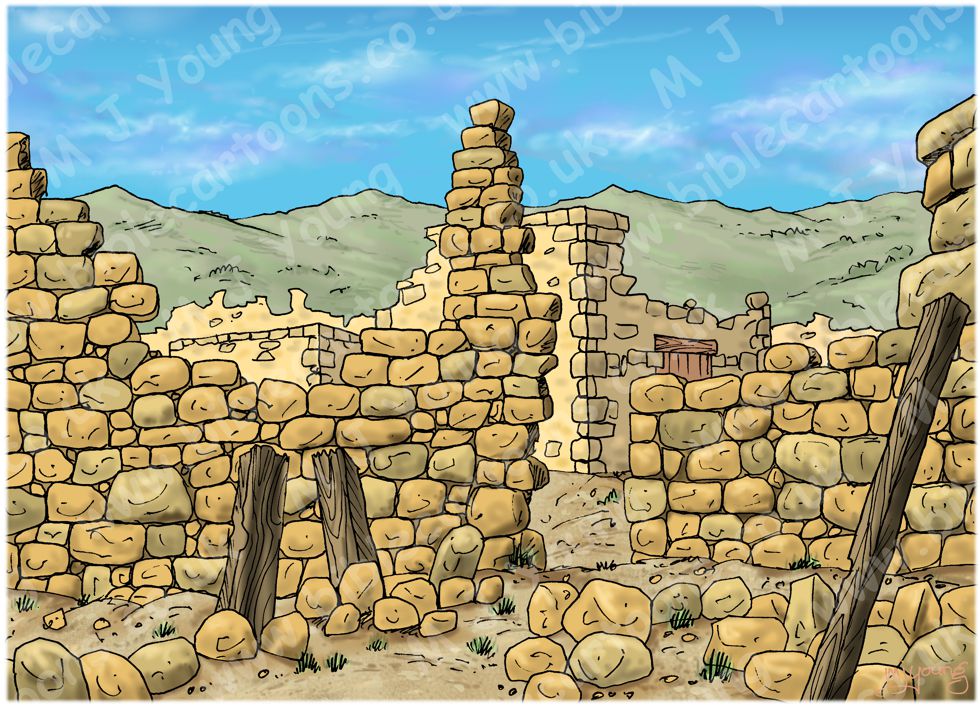
Background of Nehemiah 02 – Nehemiah inspects Jerusalem’s walls – Scene 05 – Plans revealed
Click on the colour bar below to view/buy this Background:
Background of Nehemiah 02 – Nehemiah Jerusalem’s walls – Scene 05 – Plans revealed
Here’s the rough pencil sketch I drew for this scene.
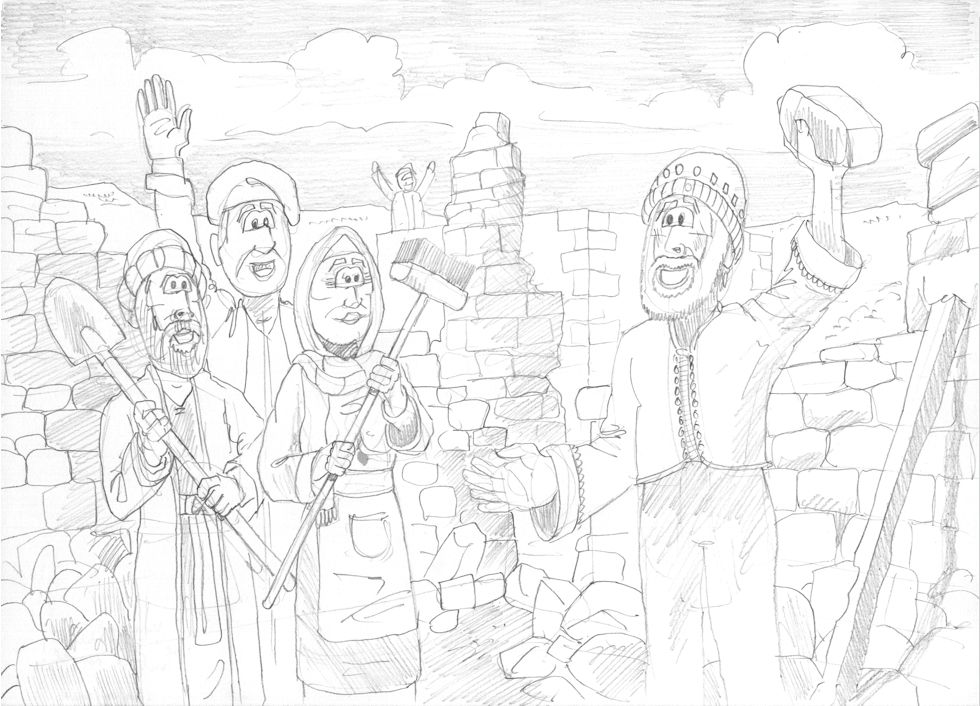
Nehemiah 02 – Nehemiah inspects Jerusalem’s walls – Scene 05 – Plans revealed – Greyscale PENCIL
The three birds flying overhead are Cinnyris osea (aka Palestine sunbird).
The Palestine sunbird is 3.14-4.7 Inches (8 to 12 cm) long with a wingspan of 5.5-6.3 inches (14 to 16 cm). Males have an average weight of 0.26 Ounces (7.6 grams) and females weigh around 0.24 ounces (6.8 grams). The bill is fairly long, black and curves downwards. The plumage of breeding males is mostly dark but appears glossy, iridescent blue or green in the light. There are orange tufts at the sides of the breast which are hard to see except at close range. Females and juveniles are grey-brown above with pale underparts. Non-breeding males are similar but may retain some dark feathers.
It has a high, fast, jingling song and various calls including a harsh alarm call.
The Palestine sunbird occurs in areas with high temperatures and dry climate from sea level up to an altitude of 3200 m. It inhabits dry woodland, scrub, wadis, savannas, orchards and gardens. It is common in towns in some areas.
The diet consists mainly of insects and nectar. The tongue is long and brush-tipped to extract nectar from flowers
The Middle Eastern subspecies C. o. osea breeds from Israel, Palestine and Jordan in the north, down through western Saudi Arabia to Yemen and Oman in the south. The expansion of Israeli cities, towns and villages over the last century played a significant role in the spread of the Palestine sunbird throughout the region, with cultivated tropical plants becoming more common in urban gardening. In recent decades it has colonized the Sinai Peninsula in Egypt. It has been observed breeding in Lebanon and regularly winters in both Lebanon and Syria.
[Source: https://www.inaturalist.org/taxa/145180-Cinnyris-osea]