Bible Cartoon: John 03 - Jesus and Nicodemus - Scene 01 - Night visit
Click on Add to cart button below shopping cart.
Purchased Bible Cartoons do not have watermarks. Links to Cartoons provided on email once purchase is completed.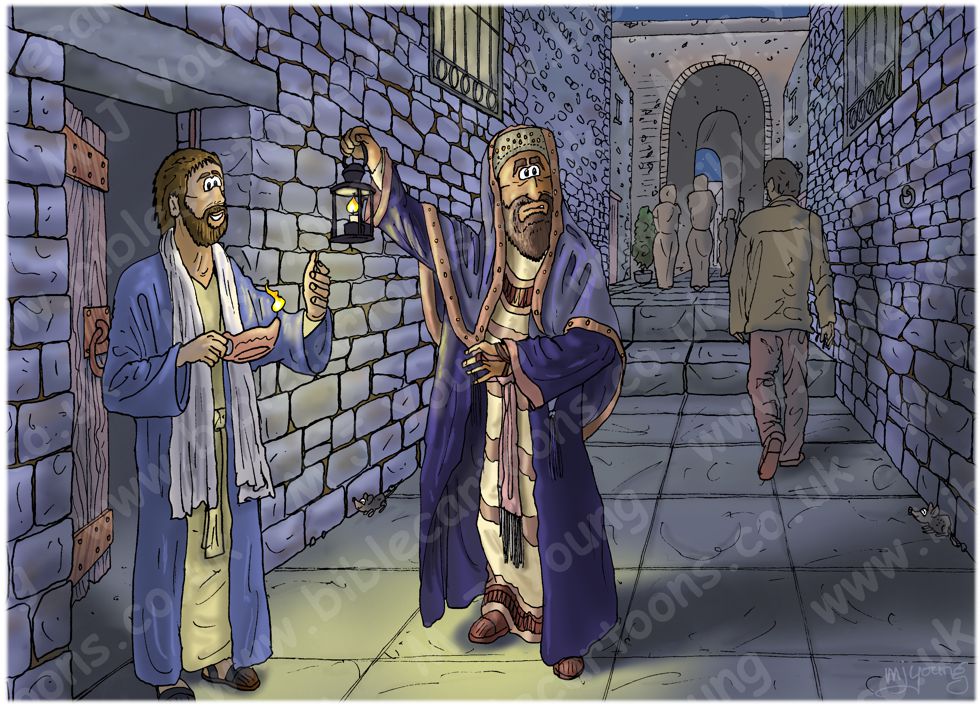


Bible Book: John
Bible Book Code: 4300300102
Scene no: 1 of 5
Bible Reference & Cartoon Description
John 3:1-2 (ANIV)
Jesus teachers Nicodemus
1 Now there was a man of the Pharisees named Nicodemus, a member of the Jewish ruling council. 2 He came to Jesus at night and said, “Rabbi, we know you are a teacher who has come from God. For no-one could perform the miraculous signs you are doing if God were not with him.”
DRAWING NOTES:
TIME OF DAY:
Verse 2 informs us this scene takes place at night.
LIGHTING NOTES:
The main light sources are the lamps Jesus and Nicodemus are holding up, which cast shadows away from these figures. There is also feint light coming a lamp in a room above Nicodemus’s head on the left hand wall.
CHARACTERS PRESENT:
Jesus and Nicodemus in the foreground, various men and women passers-by behind them.
Two little street mice!
RESEARCH/ADDITIONAL NOTES:
This picture shows a furtive and anxious-looking Nicodemus arriving at the house Jesus and his disciples are staying in at night. I think Nicodemus sought out Jesus under the cover of darkness so that no one else would see him, particularly any other members of the Pharisees and especially any other members of the Sanhedrin (or Jewish ruling council).
The scene is set in a narrow street in Jerusalem. We know Jesus was in Jerusalem at this time because John chp 2 verse 13 informs us that Jesus had gone to that city to celebrate Passover.
Here’s the scene without the figures in the picture.

Background of John 03 – Jesus and Nicodemus – Scene 01 – Night visit
Click on the colour bar below to view/buy this Background:
Background of John 03 – Jesus and Nicodemus – Scene 01 – Night visit
In the original creation of this picture I had Nicodemus wearing a leather strap on his left hand (called a Phylactery). However, research has since shown me that these items are not worn after sunset, and Nicodemus visited Jesus at night, therefore I have removed the item from the figure in this picture.
A note about Phylacteries (tefillin).
A Phylactery is a small leather box containing Hebrew texts on vellum, worn by Jewish men, worn on the left arm and on the head by observant Jewish men and especially adherents of Orthodox Judaism during morning weekday prayers. Their purpose is a reminder to keep the law. They represent a divine commandment to bind God’s words as a sign upon the hand and between the eyes, symbolizing dedication of intellect and actions to God.
Phylacteries (tefillin) are worn in Jewish culture exclusively during the daytime, primarily during weekday morning prayer services (Shacharit). They can be put on from the time known as misheyakir—when there is enough daylight to distinguish between blue and white threads, or to recognize an acquaintance from a short distance. They may be worn anytime during the day until sunset. Phylacteries (tefillin) are worn on weekdays (Sunday through Friday), but they are not worn on Shabbat or major Jewish holidays (such as Passover, Shavuot, Rosh Hashanah, Yom Kippur, and Sukkot) because those days are considered “signs” themselves.
Phylacteries (tefillin) are not worn at night, as that is not considered their appointed time.
Bible Doctrine Notes
3:1-5 SALVATION, As New Birth (4.24E)
What Jesus said to Nicodemus about being “born again” relates to us all: all people need to be “born again” in order to enter the kingdom of God; there is NO OTHER way in. To be “born again” means to be born from above; it is solely and completely the work of God, it can not be achieve by human effort. Only the Holy Spirit can give this new birth to us. As Jesus pointed out, this new birth is mysterious, like the unseen blowing of the wind. It is a miracle instigated and achieved by God alone, analogous to the virgin birth of Jesus Christ (see Matthew 1:18-25; Luke 1:34-35). It is also analogous to God’s first act of creation (see Genesis 1:1-2).
It is from this passage in John that we get our phrases “new birth”, “regeneration”, “second birth”, “twice-born” and “born again”.
Verses 14-15 are crucial to understanding how we get this second birth…
14 [Jesus said] “Just as Moses lifted up the snake in the desert, so the Son of Man must be lifted up, 15 that everyone who believes in him may have eternal life.”
This phrase refers to the incident in Numbers 21:4-9. The new birth is only possible through Jesus Christ’s sacrificial death on the cross and via faith in Him as God’s antidote for the terrible poison of sin (see John 8:28; 12:32-33).
John 8:28 So Jesus said, “When you have lifted up the Son of Man, then you will know that I am the one I claim to be and that I do nothing on my own but speak just what the Father has taught me.”
John 12:32-33 “But I, when I am lifted up from the earth, will draw all men to myself.” 33 He said this to show the kind of death he was going to die.”
The new birth is the door to eternal life, and the phrase “Eternal life” is another way of referring to the kingdom of God in John’s gospel. Compare John 1:13; Ezekiel 37:1-10; 2 Corinthians 5:17; Ephesians 2:15; Titus 3:5; 1 Peter 1:3,23; Revelation 21:5.
3:2 JESUS CHRIST, Teaching (1.24A)
Jesus is referred to as a teacher or “Rabbi” in the New Testament, a title and description Nicodemus recognized. A teacher/Rabbi was one of many Jewish interpreters of the Law, who gathered disciples and performed authenticating signs. John 3:2 shows us that Nicodemus knew Jesus came from God, just as he responded to the mighty works and miracles he had heard Jesus had performed. Compare John 1:38, 49; 3:2, 26; 6:25; 20:16. The term teacher/Rabbi implies all the traditional reverence and respect which Judaism assigned to wisdom and instruction. But Jesus was critical of the exaggerated place of teachers who desired compliments more than they wanted to serve the people (see Matthew 23:7-8). Jesus knew that Nicodemus’ respectful form of address did not issue from a heart of saving faith. Remember John 2:24-25 which states “24 But Jesus would not entrust himself to them, for he knew all men. 25 He did not need man’s testimony about man, for he knew what was in a man.”
Jesus must be seen as much more than merely a powerful teacher.
3:2 MIRACLE, Vocabulary (2.21C)
For Nicodemus the miraculous signs Jesus performed signified that God was with Jesus and authenticated Jesus as a Teacher of God’s truth. Nicodemus did not question the miraculous nature of Jesus’ works. See note on John 2:11.