Bible Cartoon: Genesis 02 - Adam and Eve - Scene 01 - God makes man
Click on Add to cart button below shopping cart.
Purchased Bible Cartoons do not have watermarks. Links to Cartoons provided on email once purchase is completed.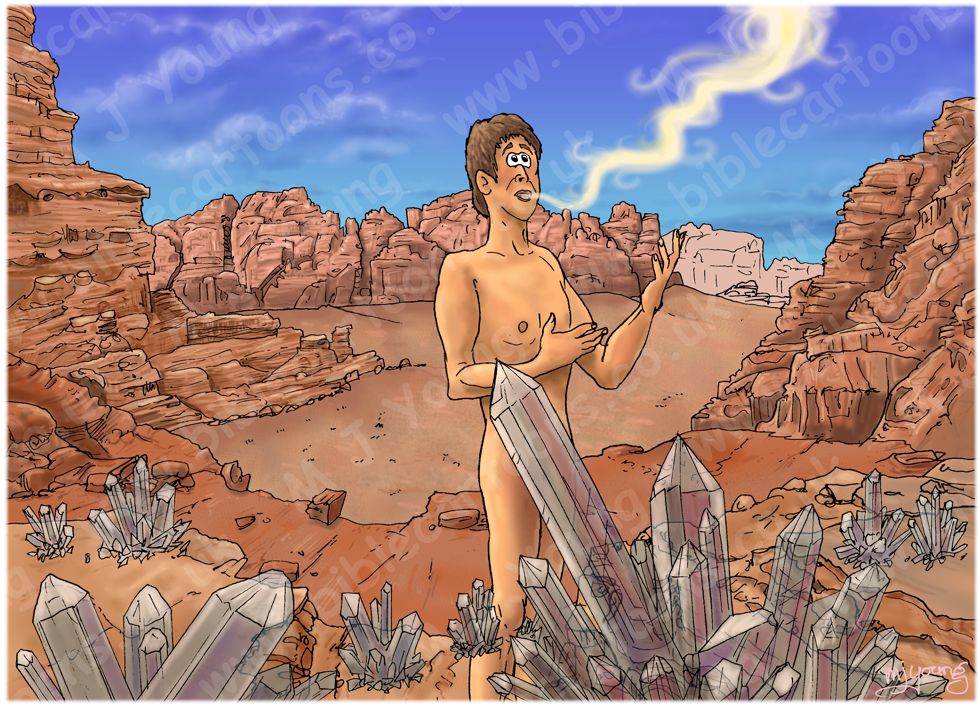


Bible Book: Genesis
Bible Book Code: 0100200401
Scene no: 1 of 6
Bible Reference & Cartoon Description
Genesis 2:4b-7 (NLT)
Adam and Eve in Eden
[4aThis is the account of the creation of the heavens and the earth.] 4b When the Lord God made the earth and the heavens, 5 neither wild plants nor grains were growing on the earth. The Lord God had not yet sent rain to water the earth, and there were no people to cultivate the soil. 6 Instead, springs [1] came up from the ground and watered all the land. 7 Then the Lord God formed the man from the dust of the ground. He breathed the breath of life into the man’s nostrils, and the man became a living person.
[1]
Or, mist.
DRAWING NOTES:
TIME OF DAY:
Unspecified in the Bible narrative.
LIGHTING NOTES:
The sun (unseen, above left) illuminates this scene, casting shadows below & to the right of objects.
CHARACTERS PRESENT:
The man: Adam.
RESEARCH/ADDITIONAL NOTES:
There are two versions of this scene:
01) (This page) Genesis 02 – Adam and Eve – Scene 01 – God makes man. This is the original version.
02) (Next page) Genesis 02 – Adam and Eve – Scene 01 – God makes man (Modest version). In this version I have added some additional crystals, strategically placed to cover up more of the naked body of Adam. I added this version in deference to more sensitive viewers/customers.
I noticed that in verse 5 the Bible states that there were no wild plants or grains growing on the earth, which is why I have illustrated a sandy, rocky desert scene, devoid of any plant growth.
I like earth science & geology in particular, so saw an opportunity to illustrate some large crystal masses in the picture… in addition, one of the crystals maintains Adam’s modesty!
The divine breath of life can be seen coming down from heaven and entering the man, thus instantly imbuing him with life. I didn’t draw the springs (or mist) mentioned in verse 6. Adam Clarke’s Commentary provides some interesting observations on the subject (see below commentary).
Here is the scene without the figure in the foreground.
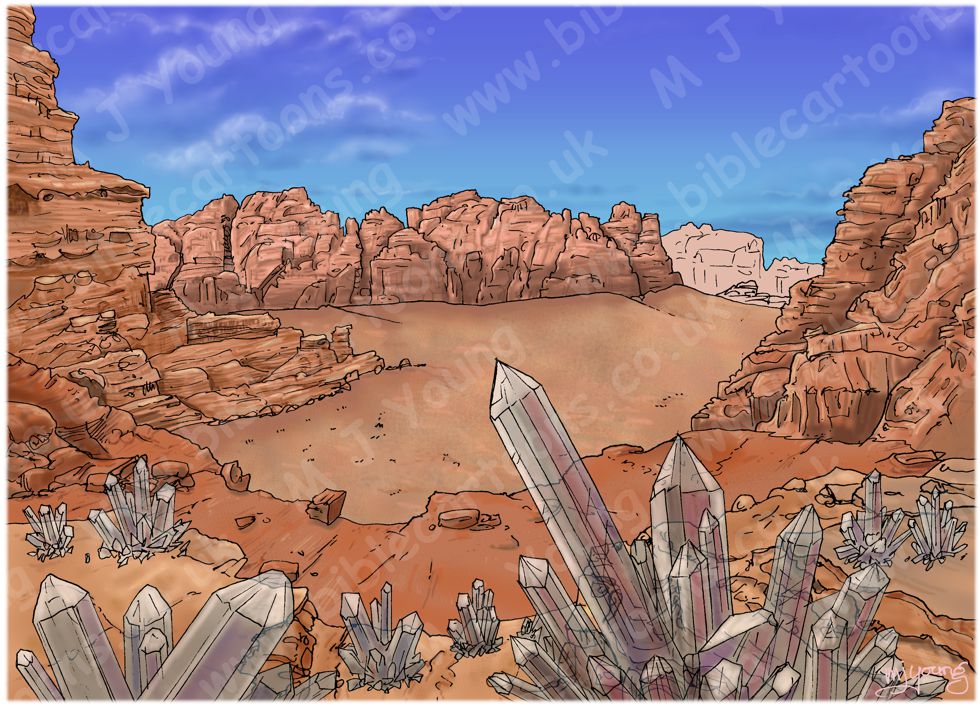
Background of Genesis 02 – Adam and Eve – Scene 01 – God makes man
Click on the colour bar below to view/buy this Background:
Background of Genesis 02 – Adam and Eve – Scene 01 – God makes man
“There went up a mist—This passage appears to have greatly embarrassed many commentators. The plain meaning seems to be this, that the aqueous vapours, ascending from the earth, and becoming condensed in the colder regions of the atmosphere, fell back upon the earth in the form of dews, and by this means an equal portion of moisture was distributed to the roots of plants, etc. As Moses had said, Genesis 2:5, that the Lord had not caused it to rain upon the earth, he probably designed to teach us, in Genesis 2:6, how rain is produced, viz., by the condensation of the aqueous vapours, which are generally through the heat of the sun and other causes raised to a considerable height in the atmosphere, where, meeting with cold air, the watery particles which were before so small and light that they could float in the air, becoming condensed, i.e., many drops being driven into one, become too heavy to be any longer suspended, and then, through their own gravity, fall down in the form which we term rain.”
[Source: Adam Clarke’s Commentary]
Bible Doctrine Notes
2:4 HISTORY, Linear (3.31B)
History as recorded in the Holy Bible is concerned with the created world and its generations. The word “account” (see Genesis 5:1; 6:9; 10:1; 11:10-27; 25:12,19; 36:1,9; 37:21) is an English translation of the Hebrew word toledoth which means both an account of a people’s history and the generations of people who participated in those times. Many of Israel’s neighbouring countries focussed on heavenly activities, whereas the Bible focusses on earthly activities. Other nation’s religions focussed on repeated acts in the divine world which determined the fate of the world inhabited by human beings. Uniquely, the Bible points to the Lord God’s new acts to relate to new generations of people. The creation account is not a mythical fight among the “gods”, but rather an earthly action by the one God to prepare a place for human beings, with whom God wanted to relate in love and freedom.
2:4-17 FAMILY, Environment (5.81D)
In contrast with later philosophies which taught that matter was evil, the Holy Bible positively identifies God as the creator of the earth and all that is in it. The first chapters of Genesis introduce the theme of appreciation for the physical environment. Human beings were provided with an environment on earth that promotes growth, and we were entrusted with the responsibility to use it well and wisely. This stewardship is even more important today, for families to be able to survive materially and economically. (see Genesis 1:28-31).
2:7 HUMANITY, Physical Nature (2.42B)
Human beings are uniquely distinct from all other animal life in that we are created in God’s image (see note on Genesis 1:26-29). However, the terms used to describe humanity here are the same words used in Genesis 1:20,24 to describe other forms of animal life. Additionally, since the Lord God created human beings from the dust, any basis for human pride is justly eliminated. What makes human dust into a living person is God’s breath, therefore life comes as His gift and not as our right.