Map showing the Neo-Assyrian empire
Click on Add map to cart button below shopping cart.
Purchased Maps do not have watermarks, are high resolution (150dpi) & have crisp, clear labels/town names.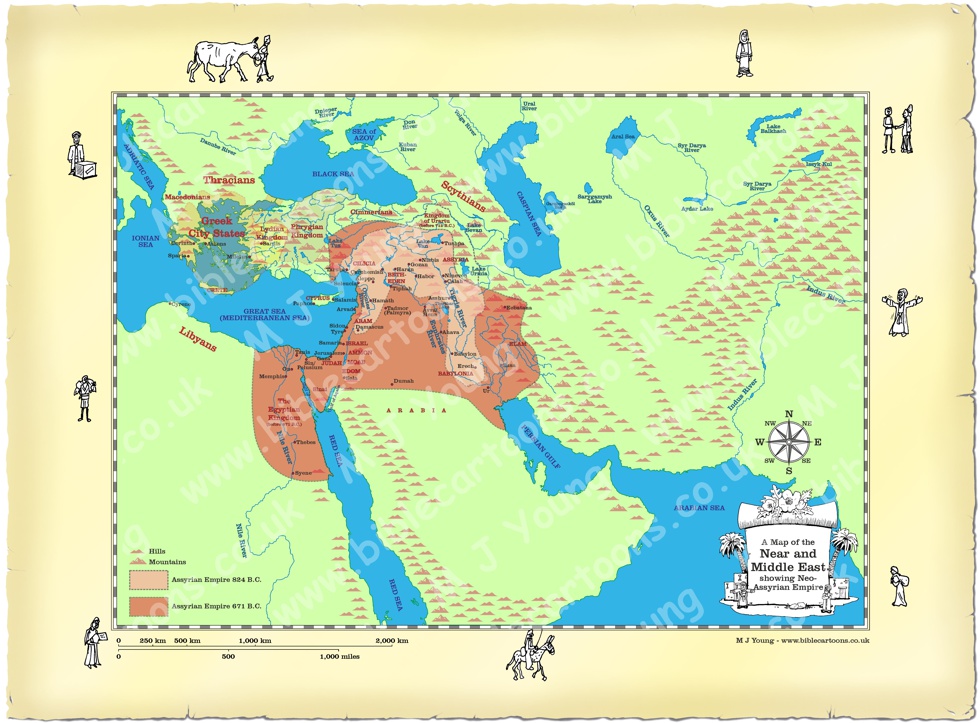
Bible Book: 2 Kings
Bible Book Code: 1200900101a
Bible Reference & Map Description
This map shows the extend of the Neo-Assyrian empire from 824 to 671 B.C.
The significance of the year 824 B.C. is that it marked the end of the long and powerful reign of King Shalmaneser III of the Neo-Assyrian Empire.
The significance of the year 671 B.C. is the conquest of Egypt by the Neo-Assyrian king Esarhaddon (aka Essarhaddon, Assarhaddon and Ashurhaddon), the third king of the Sargonid dynasty. That conquest made his empire the largest the world had ever seen. This king was also known for his reconstruction of Babylon, which had been destroyed by his father.
Is it Assyrian or Neo-Assyrian?!
The Neo-Assyrian Empire is a specific, peak phase (911–609 BCE) of the broader Assyrian civilization, which spanned over a millennium across multiple eras. “Assyria” is the overall civilization, while “Neo-Assyrian” refers to its final, largest Iron Age superpower phase.Historical Stages of Assyria
Early & Old Assyrian Periods (c. 2600–1363 B.C.): Started as a local administrative city-state centred around Ashur in northern Mesopotamia, growing into a prominent trade network.Middle Assyrian Period (c. 1363–912 B.C.): Rose to become a powerful regional kingdom after defeating the Mitanni.
Neo-Assyrian Empire (911–609 B.C.): The final, most aggressive era of military expansion that unified the Near East, Levant, and Egypt under a centralized administration.
The end of the Neo-Assyrian empire
The Neo-Assyrian Empire collapsed swiftly between 627 and 609 B.C. It was overwhelmed by internal civil wars and an invasion by a coalition of Babylonians and Medes, which destroyed major cities like Ashur and the capital, Nineveh.Notice the figures on the border of the map.
If you look carefully at the map border you will see I have included some new little black and white figures, drawn specifically for this map!
Bible References relating to 824 B.C.
The year 824 B.C. marks the final year of the reign of Assyrian King Shalmaneser III (858–824 B.C.). While 824 B.C. is not explicitly cited by calendar year in the Bible, it coincides with the era of Jehu of Israel and the geopolitical overlap between Israel and the Neo-Assyrian Empire recorded in Kings and Chronicles.Hosea 10:14: Refers to the destruction of “Beth-arbel” by a leader named “Shalman” during a day of battle. Many biblical historians and archaeologists identify “Shalman” as Shalmaneser III, whose extensive military campaigns active through 824 BC impacted the northern regions of Israel and Jordan.
1 Kings 16: 23-28 (The House of Omri): Assyrian inscriptions from this exact era (ending in 824 BC) refer to the Kingdom of Israel continuously as the “House of Omri” (Bit-Humri), showing how contemporary political entities matched the biblical dynastic naming conventions.
Bible References
Who ruled in Northern Israel (the divided kingdom) during 824 B.C.?
King Jehu (approx reign dates: 841–814 B.C.)
Jehu’s history is recorded in 2 Kings 2 chapters 9 and 10. He ruled for 28 years.
Who ruled in Judah (the divided kingdom) during 824 B.C.?
King Joash (aka Jehoash): (approx reign dates: 835–796 B.C.)
Joash’s history is recorded in 2 Kings chapters 11 and 12 and 2 Chronicles 22:10 to 2 Chronicles 24:27. He ruled for 40 years.
Bible References relating to 671 B.C.
The year 671 BC marks the historical conquest of Egypt by the Assyrian king Esarhaddon, an event tied to biblical prophecies concerning Egypt’s judgment and references to Assyrian rulers. While the Bible does not cite the exact calendar year “671 B.C.,” it records the geopolitical players, regional conflicts, and successors active during this exact period.The northern Kingdom of Israel had already fallen and ceased to exist by 671 B.C. so there was no king reigning there at this time.
Who ruled in Judah (the divided kingdom) during 671 B.C.?
King Manasseh: (approx reign dates: 687–642 B.C.)
Manasseh is recorded in 2 Kings 21:1–18 and 2 Chronicles chapter 33:1-20. He ruled for 55 years.
2 Chronicles 33:11–13: Details the capture and deportation of King Manasseh of Judah by Assyrian commanders, a punitive action occurring under the hegemony of Esarhaddon and his successor.
Isaiah 19:1–4: Many biblical scholars link the prophecy of Egypt’s internal collapse and submission to a “cruel lord and fierce king” to Esarhaddon’s invasion and sacking of Memphis in 671 B.C.
2 Kings 19:9 & Isaiah 37:9: Mention Tirhakah (the historical Pharaoh Taharqa of Cush/Ethiopia), who fought against the Assyrian empire during this broader era of conflict.
2 Kings 19:37 & Isaiah 37:38: Record the death of Sennacherib and the ascension of his son Esarhaddon to the Assyrian throne, the very king who led the 671 B.C. campaign.
Ezra 4:2: References Esarhaddon directly regarding the Assyrian policy of resettling foreign peoples into Samaria, which destabilized the region during the 7th century B.C.