Gospel Illustration: The Christian journey - Scene 12 - Sudden distractions along the way (Male)
Click on Add to cart button below shopping cart.
Purchased Gospel Illustrations do not have watermarks. Links to Illustrations provided on email once purchase is completed.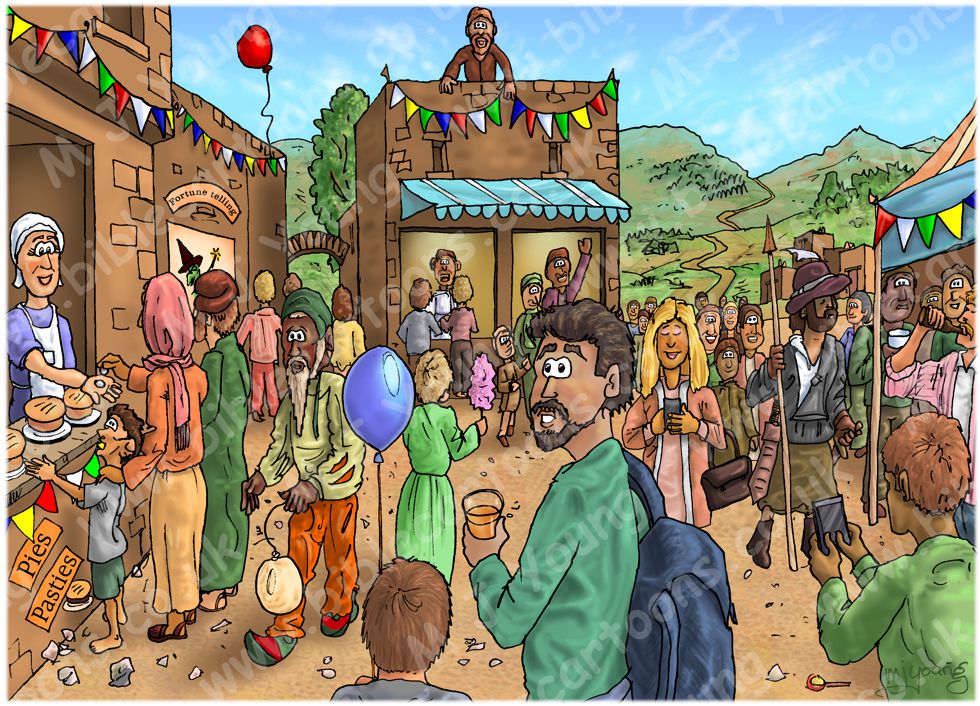

Illustration code: 7000601402
Scene no: 12 of 16
Illustration Description
This is the twelfth scene in my series of The Christian journey illustrations & the last one set in the summer time, which represents the man’s middle life, both in terms of his chronological age and deeper Christian understanding and experience.
The man with dark brown hair, a green shirt & jeans has been walking steadily forward in her faith journey, but suddenly she finds herself walking into a village in which a garden fete or fair is taking place. There are stalls, tents, colourful bunting & many people enjoying all the fun & entertainments on offer. This is a bustling, exciting environment, full of exotic sights, sounds & smells: there are games to play, food and drink to try, and much to beguile & charm.
Pale sunlight from the sun (off to the right) is illuminating this scene, casting shadows below & to the left of figures & objects. The man with dark brown hair, a green shirt & jeans is holding a glass of beer and has an expression of surprise, or wonder on her face.
There is nothing at all wrong with fetes or fairs, in themselves… God is not opposed to us having fun, after all, He invented it! [1] However, in the context of the man with dark brown hair, a green shirt & jeans making progress in his Christian faith journey, I have simply used the village fete/fair as an example of a distraction to his onward journey. That “onward journey” is, in fact, the road we can see leading out of the village & over the distant hills. That’s the way he needs to go; “success” is travelling that road, not remaining in the village fete/fair.
There are any number of things, situations & people who can present themselves, & which can act as a distraction from pursuing the Lord God. I could have depicted the man watching too much television, “doom scrolling” on mobile phones (as some people in my picture are!), getting drunk at a pub, taking drugs, working too much, focussing too much on his own enjoyment, etc, etc. Anything which takes away the central importance & devotion to God can be a distraction. I have simply used the fete/fair as visual representation of any/all distractions in life.
As a matter of fact, I have illustrated some aspect of the fete/fair which is a genuine spiritually unhealthy activity, which could be harmful to the man with dark brown hair, a green shirt & jeans. Notice that off to the left there is a fortune teller, depicted as a witch in a pointed hat on a poster, which certainly could be a problem & potential threat to the man, were he to participate in that activity.
The problem with witchcraft
The Bible (in both the Old & New Testaments) strictly forbids witchcraft, sorcery, divination, and communicating with the dead, viewing them as spiritual rebellion and acts which are detestable to God.
Exodus 22:18: States, “Do not allow a sorceress to live” (or “Thou shalt not suffer a witch to live” in traditional translations).
Leviticus 19:26 & 20:27: Forbids practicing divination or sorcery, and mandates that mediums or necromancers be put to death.
Deuteronomy 18:10–12: Bans a wide range of practices, including fortune-telling, interpreting omens, casting spells, consulting mediums or spiritists, and calling upon the dead. These acts are called an “abomination to the Lord”.
1 Samuel 28: Describes King Saul consulting the witch of Endor to summon the spirit of the prophet Samuel, an act of unfaithfulness (to God) that contributed to his (king Saul’s) downfall.
Galatians 5:19–21: Lists “witchcraft” (or sorcery/pharmakeia) among the “works of the flesh,” warning that those who practice such things will not inherit the kingdom of God.
Revelation 21:8 & 22:15: Explicitly places sorcerers among those excluded from the holy city or consigned to spiritual judgment.
Why the Bible warns against & forbids these practices.
These practices represents a rejection of God’s authority/sovereignty in favour of seeking hidden knowledge or power through supernatural or spiritual forces apart from Him, which opens up one’s life to negative, unholy spiritual (daemonic) forces.
It often ties into the pagan or animistic practices of surrounding ancient nations that opposed worship of the Lord God & is therefore a form of idolatry.
[1]
Bible references to God inventing fun.
Scripture presents God as the source of joy, laughter, and pleasure, framing wholesome fun and recreation as intentional gifts rather than accidental impulses.
Key Biblical Passages and Evidence
Ecclesiastes 9:7: “Go, eat your food with gladness, and drink your wine with a joyful heart, for God has already approved what you do.” This passage shows that enjoying the simple, pleasant moments of life has divine approval.
Ecclesiastes 3:12–13: “I know that there is nothing better for people than to be happy and to do good while they live. That each of them may eat and drink, and find satisfaction in all their toil—this is the gift of God.” Satisfaction and happiness in daily life are explicitly categorized as gifts from God.
Psalm 104:26: Mention is made of Leviathan (the sea creature) which God formed “to frolic [or play] in it,” illustrating that playfulness and delight exist within the natural world God designed.
Proverbs 17:22: A cheerful heart is good medicine, but a broken spirit saps a person’s strength.
John 10:10: Jesus states, “I have come that they may have life, and have it to the full,” pointing to an abundant life that encompasses joy and well-being.
1 Timothy 6:17: God “richly provides us with everything for our enjoyment.” Material blessings, food, and shared human happiness are meant to be received with gratitude.
James 1:17: “Every good and perfect gift is from above, coming down from the Father of the heavenly lights…” Wholesome enjoyment, beauty, and recreation fall under the umbrella of good gifts provided by the Creator.