Gospel Illustration: The Christian journey - Scene 09 - Rough roads (Male)
Click on Add to cart button below shopping cart.
Purchased Gospel Illustrations do not have watermarks. Links to Illustrations provided on email once purchase is completed.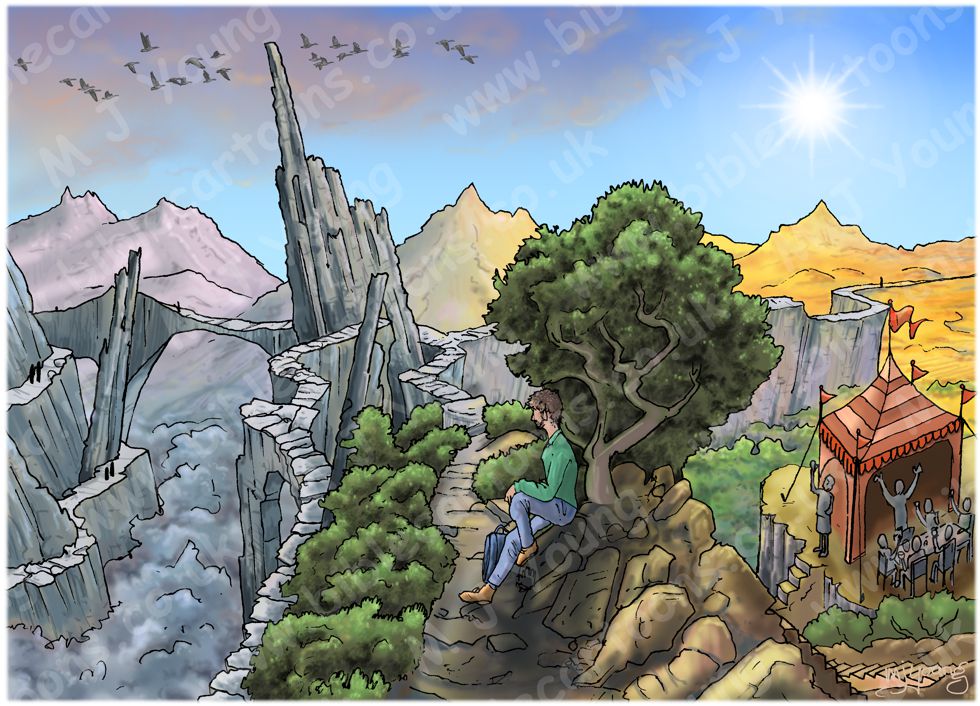


Illustration code: 7000601102
Scene no: 9 of 16
Illustration Description
In this ninth scene we see the young man with dark brown hair, a green shirt & jeans sitting by a pathway beneath a dense, thorny gorse bush. This is the first scene in the summer time set of 4 pictures. Summer represents the man’s middle life, both in terms of his chronological age and his deeper Christian understanding and experience.
Beyond the sitting man, the rocky path snakes off into the distance, into a barren, rocky, treacherous looking landscape. There is a chasm off to the left, filled with mist in the deep gorge far below, representing uncertainty in life and obscured outcomes if that path is taken. A rocky pathway also leads off to the right, into a dry, hot, sandy desert.
As with many of the scenes I have drawn in this series, this picture shows multiple directions in which the man may go. As stated in previous pictures, these different pathways represent the various choices people have as they journey through their lives here on earth.
A note about the tent of temptation!
Notice the tent, table and beckoning figures in the bottom right hand corner of the picture. The shadowy figures are sitting round a table, apparently enjoying a party. There is a stone pathway and steps leading down to the tent from where the man is sitting. The tent and figures represent the many different distractions & temptations Christians can experience, as they walk the way of Jesus. The figures are beckoning to the man to join them and take it easy; to forget the more arduous pathway she is considering; to take the way of ease and pleasure. This is a spiritual trap set by the Devil. He strikes whenever we face a difficult choice or are uncertain about which way to go. Satan is quick to supply a seemingly easier, less difficult pathway to a Christian, knowing full well that the way of ease and remaining stationery will not advance us, our lives, nor the cause of Christ, at all.
Although not obvious in the scene, the “right” direction for the man to go is off to the right, into the heart of the hot, yellow, arid desert. That way leads to hardship & discomfort, yet it is the way the Lord God wants the man to go. Nevertheless, she could choose to turn back & retreat, or else go to the left and wander the rocky pathways that twist & turn endlessly, off to the left. Neither way appears particularly appealing! I suppose he is resting under the cool shelter of the thorny gorse bush, wondering which way to go next.
This scene reminds us that sometimes the going gets tough in the Christian life, and there is not an obvious “right” pathway to take. Perhaps in previous times (especially in his early Christian life), the man experienced a clearer signal from God, telling his which way to go. As he matures in his faith, and grows deeper in his experience and understanding of God, paradoxically the way seems less clear, less certain. He needs to draw on more character strength from within herself; rely and lean more heavily on what he has read in the Bible, and has experienced and come to know about God, as he faces the tougher times in his life.
The summer set of 4 pictures represent a more mature Christian man, in the middle of his life, perhaps many years into his faith walk with Jesus. In the early days of our relationship with Jesus, the Lord God often answers our immature prayers and childish ways with grace and affirmation. He seems to be close by, often making His presence felt to us. However, it is many more mature Christian’s experience that, later on, Jesus sometimes feels further away, or even apparently absent from our experience altogether. This is most definitely NOT the case: Jesus does not abandon us at all, for He promised in the Bible (in the New testament, in the book of Hebrews 13:5) “Never will I leave you; never will I forsake you.” This is a quote of Moses’ words to the Hebrew people as they were about to enter the Promised land, found in Deuteronomy 31:6. The promise is repeated to Joshua, in the book bearing his name, in chapter 1 verse 5 “No one will be able to stand against you all the days of your life. As I [the Lord God] was with Moses, so I will be with you; I will never leave you nor forsake you.” For this reason we can be sure that God NEVER leaves us… so why do we sometimes experience a season in our lives when God seems far away?
Why do we go through hard times in life?
It seems to me that our heavenly Father operates in our Christian lives rather like a parent of a child… at least at first in our earliest time as a new Christian. If a parent of a child always held that child close & never let them go anywhere without us; never let them experience any difficulty or trial, they would surely remain a child, never growing up, they would remain utterly dependant & immature. If that parent allows their child to gradually experience difficulties or troubles in life, then (it is hoped that) they will develop strength of character, strength of will, strong determination, patience, tenacity, perseverance & eventually mature into a well rounded follower of Jesus, able to withstand the hardships of life and the spiritual attacks of the enemy (Satan).
Many of the traits I have just mentioned (eg patience, tenacity) can’t simply be gifted to a child/Christian, they have to be developed over time by experiencing difficulties and trials… it is these hard situations that produce the strong character traits mentioned above. I believe this is exactly why the Lord God allows us to experience these hard times… it is His way of developing our character, and helping us to become more like His son Jesus the Christ.
When we look at the life of Jesus on earth we see that He endured many trying times & difficulties. For example there is the 40 days in the wilderness without food, just after Jesus’s baptism. During that trial the Devil tempted Jesus in all sorts of ways, yet Jesus did not give in to temptation.
The prophet Isaiah described “the suffering servant” in chapter 53:2b-3 in this way, “He had no beauty or majesty to attract us to him, nothing in his appearance that we should desire him. 3 He was despised and rejected by mankind, a man of suffering, and familiar with pain.” It is believed that the suffering servant was a prophecy about Jesus, given at least 540 years before Jesus was born. Certainly the recorded life and death of Jesus points to someone who went through a lot of trials and troubles in his short 33 years of life here on earth. If Jesus’s life is intended to be the ultimate example of a good, well spent & successful life, then we should expect opposition, and difficulties in our own experience, when wanting to emulate His lifestyle.