Bible Cartoon: Mark 01 - The mission of John the Baptist - Scene 03 - John preaching
Click on Add to cart button below shopping cart.
Purchased Bible Cartoons do not have watermarks. Links to Cartoons provided on email once purchase is completed.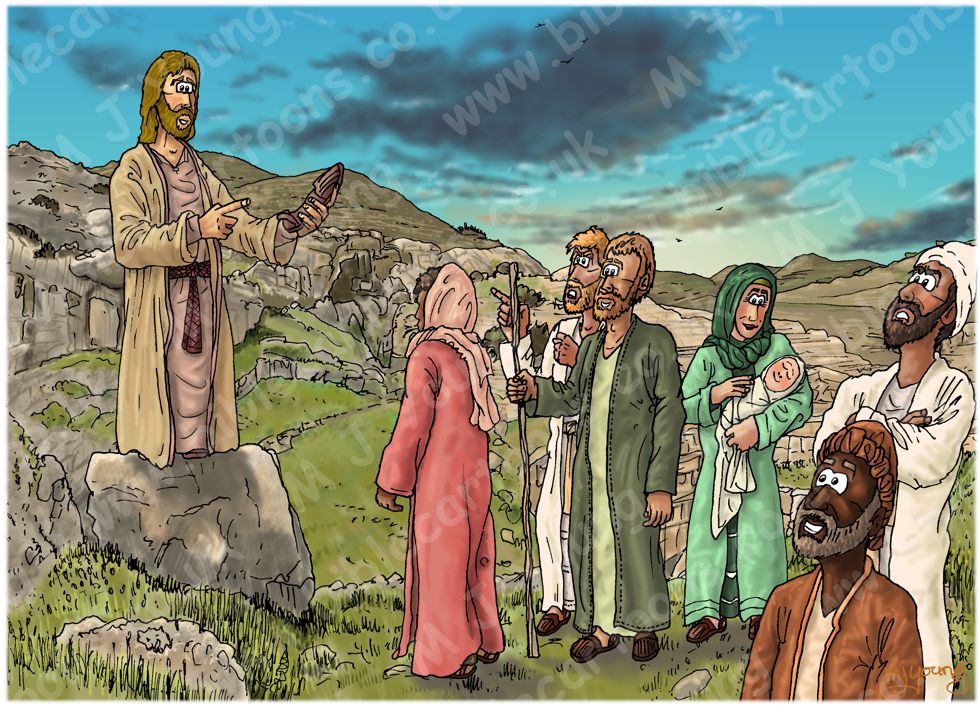



Bible Book: Mark
Bible Book Code: 4100100601
Scene no: 3 of 3
Bible Reference & Cartoon Description
Mark 1:6-8 (NLT)
6 His [John the Baptist’s] clothes were woven from camel hair, and he wore a leather belt; his food was locusts and wild honey. 7 He announced: “Someone is coming soon who is far greater than I am—so much greater that I am not even worthy to be his slave. [1] 8 I baptize you with [2] water, but he will baptize you with the Holy Spirit!”
[1]
Greek, to stoop down and untie his sandals.
[2]
Or, in; also in 1:8b.
DRAWING NOTES:
TIME OF DAY:
Not specified in the Bible narrative. I have set this scene in the early afternoon.
LIGHTING NOTES:
The unseen sun (high in the sky on the left) casts shadows below and to the right of figures and objects.
CHARACTERS PRESENT:
On the left is John the Baptist, standing on a large rock. To the right are various Hebrew people.
RESEARCH/ADDITIONAL NOTES:
This scene shows John the Baptist preaching to people in the Judean wilderness. People had a variety of different reactions to John’s preaching. We know (from verse 6) that “People from Jerusalem and from all over Judea travelled out into the wilderness to see and hear John.” Some of those people viewed him as a major prophetic voice or Elijah-figure, were convicted by his words and repented of their sins & were baptised in the Jordan river by him. Still others rejected John’s words & opposed him. In Luke 7:29–30 the author of the gospel noted that the Pharisees and experts in the law rejected God’s purpose for themselves by not being baptized by John, unlike the tax collectors and common people who acknowledged God’s justice. The chief nemesis of John the Baptist was the king Herod Antipas, who locks John in prison after John condemns Herod’s marriage to Herodias and his broader wrongdoing. (Unlike Matthew and Mark, Luke mentions John’s imprisonment briefly in Luke 3:19–20 and later refers back to John’s beheading when Herod hears about Jesus in Luke 9:7–9, without detailing the banquet scene.)
Here is the scene without the figures, objects or log in the foreground.
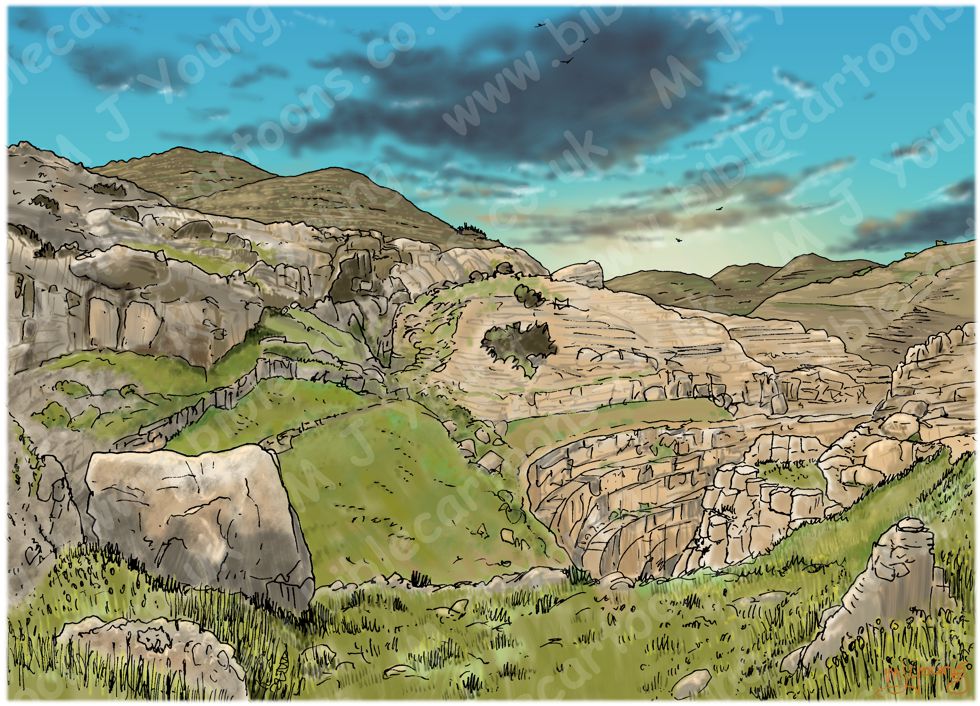
Background of Mark 01 – The mission of John the Baptist – Scene 03 – John preaching
Click on the colour bar below to view/buy this Background:
Background of Mark 01 – The mission of John the Baptist – Scene 03 – John preaching
Did the Jewish people understand John the Baptists reference to the Holy Spirit in Mark 1:8?
First-century Jewish listeners would have understood John the Baptist’s reference to the Holy Spirit through the lens of Hebrew Scriptures, for example Isaiah 44:3 and Ezekiel 36:25–27, which prophesied that God would pour out His Spirit upon His people in the end times for cleansing and renewal.
While they recognized the concept of the Spirit of God from the prophets (associated with divine presence, inspiration, or future restoration), they likely did not yet fully grasp the distinctively Christian realization of “baptism with the Holy Spirit” as it would later unfold at Pentecost or through personal union with Jesus Christ. Instead, they heard it as a promise that the coming Messiah would enact a powerful, divine transformation far greater than John’s preparatory water ritual of repentance.
Jewish people in the Second Temple period understood the concept of the “spirit of God” (Hebrew: Ruach ha-Kodesh) from the Hebrew Scriptures, where it was associated with prophecy, creation, and God’s presence, but they did not understand John the Baptist’s specific reference to a baptism with the Holy Spirit as a universal or standard theological doctrine at that time.
The historical and scriptural context reveals how his listeners interpreted (or failed to grasp) John the Baptist’s message. First-century Jews were well-acquainted with the idea of the Ruach (Spirit) resting upon prophets, kings, or elders in special, temporary ways. Groups like the Essenes at Qumran also practiced ritual water immersions for spiritual purification and cleansing of the flesh.
John’s teaching that the coming figure (Jesus) would “baptize with the Holy Spirit and fire” (see Matthew 3:11) was not presented as an everyday concept or a general promise for all of Israel, but as a defining, apocalyptic act belonging exclusively to the Messiah.
The New Testament records that even some of John the Baptist’s own disciples, years later, had never heard of or received the Holy Spirit in the way it was proclaimed in the early church, requiring further instruction from figures like the apostle Paul and Apollos (see Acts chapters 18 & 19).
How radical was John the Baptists preaching?
John the Baptist’s preaching was extremely radical for first-century Judea, functioning as a direct, uncompromising challenge to both the religious establishment and the social hierarchy of his time.
John’s preaching shattered the common Jewish belief that mere lineage as descendants of Abraham guaranteed salvation or immunity from God’s judgment, warning that “the axe is already at the root of the trees” and demanding tangible fruit of repentance.
John’s message ignored social, economic, and political status, scolding the religious elite (such as the Pharisees and Sadducees) as a “brood of vipers” (see Luke 3:7–8), while giving direct, counter-cultural demands to ordinary people, tax collectors, and soldiers alike.
Instead of localized, repeated ritual cleansings common in Jewish sects or the Qumran community, John’s baptism was a once-for-all, public act of confession and internal cleansing required even for people born as Jews.
Operating outside the temple system in the desolate Jordan wilderness, dressed in rough camel’s hair and a leather belt, and eating locusts and wild honey, his very lifestyle served as a stinging visual rebuke to the soft-spoken, richly adorned religious establishment.
John proclaimed that the Kingdom of Heaven was immediately at hand, demanding an immediate, total reorientation of life rather than a comfortable, status-quo religion.
How John the Baptist’s baptism differed specifically from the rituals of the Essenes or Qumran community?
John the Baptist’s baptism differed sharply from the ritual washings of the Essenes and the Qumran community in terms of its frequency, purpose, inclusivity, and spiritual leadership. While both operated in the Judean wilderness and shared an apocalyptic outlook, John transformed a traditional Jewish purity practice into a radical, prophetic rite.
Qumran/Essene ritual washings were daily and repeated. Members immersed themselves regularly to maintain ceremonial cleanliness, while John the Baptist’s Baptism was Once-for-all. It was a singular, decisive event marking a permanent turning point in a person’s life.
Qumran/Essene ritual washings were self-administered. Individuals walked down into a stepped pool (mikveh) and immersed themselves, while John administered his baptism himself. John acted as an active “baptizer,” plunging others into the water as a prophetic mediator.
Qumran/Essene ritual washings were all about ritual purity, they cleansed physical and ceremonial defilement (such as touching something unclean) required to eat communal meals or enter sacred spaces. John’s baptisms were all about moral repentance. It was an outward sign of inward forgiveness of sins and escape from impending divine judgment.
Qumran/Essene ritual washings were exclusive; only initiated, vetted members of the strict sect were allowed to use the community’s pools. John’s baptism was open to everyone, any Jew, including outcasts like tax collectors, prostitutes, and soldiers could come without joining a closed commune.
Qumran/Essene ritual washings used man-made cisterns, in carefully constructed, plaster-lined mikva’ot fed by rainwater channels, while Joh the Basptist’s washings took place in the flowing, untamed waters of the Jordan River, symbolising the Exodus and entry into the Promised Land.
Why John’s approach was unique.
In the Qumran Community Rule, a person could not be cleansed by water unless they had already submitted to the sect’s strict laws. John demanded an immediate, personal turn away from sin right at the river’s edge. Unlike the Essenes, who retreated from society to build a pure, isolated community, John sent baptised people back into their everyday jobs to live justly. Essene washings looked inward to preserve the group’s holiness, whereas John pointed outward to a coming “Mightier One” who would baptise with the Holy Spirit and fire.