Bible Cartoon: Mark 01 - The mission of John the Baptist - Scene 02 - Baptising in Jordan
Click on Add to cart button below shopping cart.
Purchased Bible Cartoons do not have watermarks. Links to Cartoons provided on email once purchase is completed.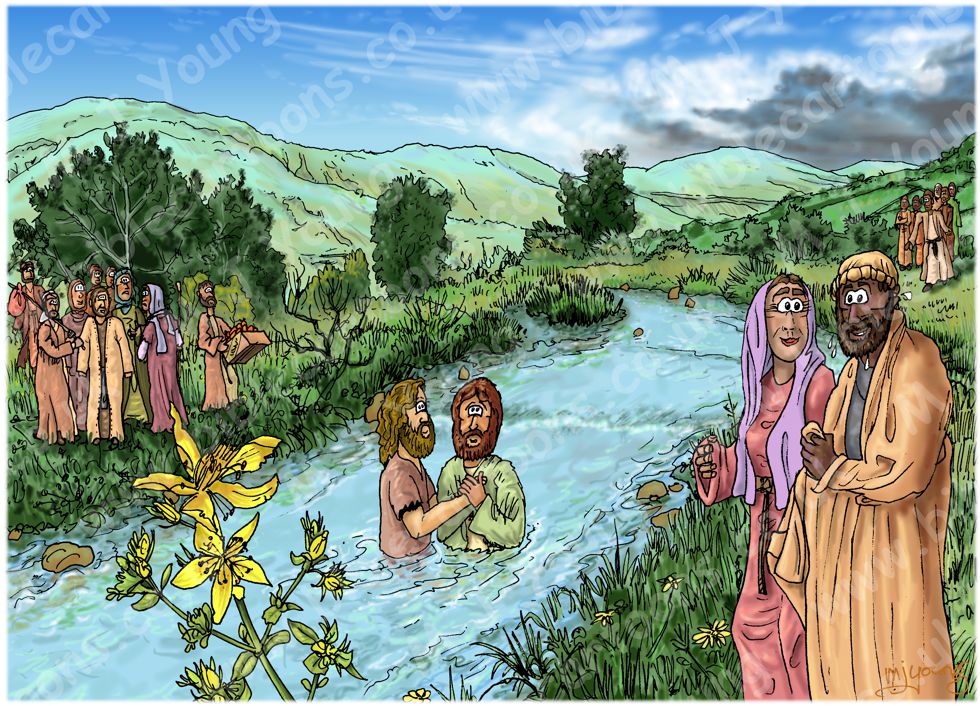



Bible Book: Mark
Bible Book Code: 4100100401
Scene no: 2 of 2
Bible Reference & Cartoon Description
Mark 1:4-5 (NLT)
4 This messenger was John the Baptist. He lived in the wilderness and was preaching that people should be baptized to show that they had turned from their sins and turned to God to be forgiven. [1] 5 People from Jerusalem and from all over Judea travelled out into the wilderness to see and hear John. And when they confessed their sins, he baptized them in the Jordan River.
[1]
Greek, preaching a baptism of repentance for the forgiveness of sins.
DRAWING NOTES:
TIME OF DAY:
Not specified in the Bible narrative. I have set this scene in the late morning.
LIGHTING NOTES:
The unseen sun (high in the sky on the left) casts shadows below and to the right of figures and objects.
CHARACTERS PRESENT:
In the river (on the left) is John the Baptist, who is baptising an un-named Hebrew man. On either bank of the river Jordan are Hebrew people come to the Jordan to be baptised. The man in the foreground on the right is dripping wet from being recently baptised!
RESEARCH/ADDITIONAL NOTES:
This scene shows John the Baptist baptising a man in the Jordan river.
The flower in the left foreground is Hypericum perforatum (aka St. John’s Wort) [1]
Here is the scene without the figures, objects or log in the foreground.
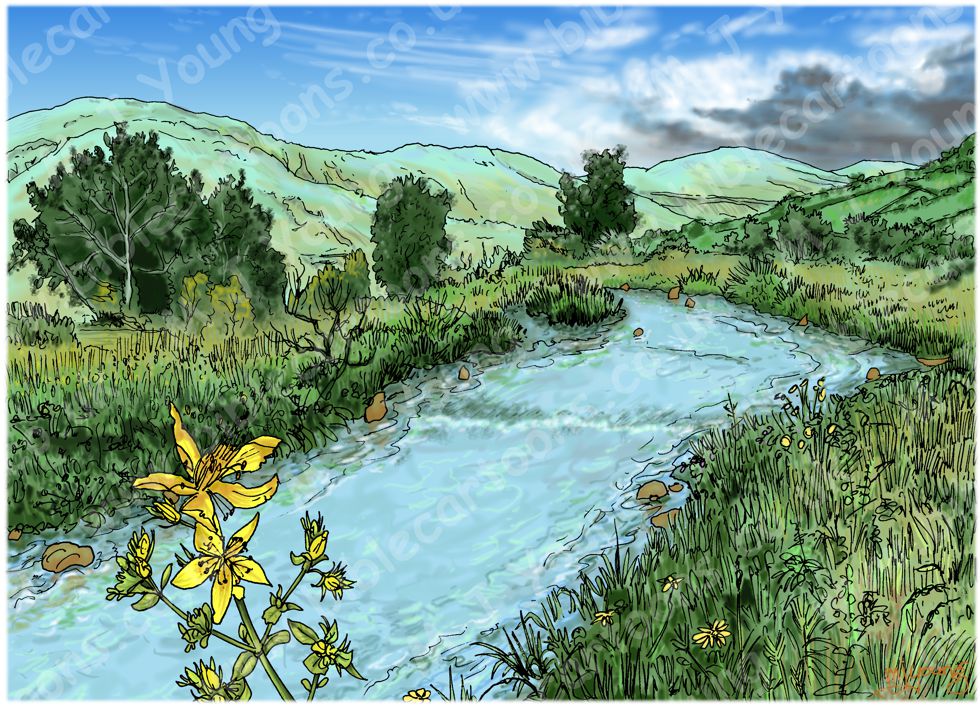
Background of Mark 01 – The mission of John the Baptist – Scene 02 – Baptising in Jordan
Click on the colour bar below to view/buy this Background:
Background of Mark 01 – The mission of John the Baptist – Scene 02 – Baptising in Jordan
John the Baptist is closely associated with several animals and plants, rooted in biblical scripture, Christian iconography, and folklore:
Animal Associations.
The Lamb – the most prominent animal symbol associated with John the Baptist is the lamb, representing his declaration of Jesus as the “Lamb of God” (John 1:36). In Christian art, John is frequently depicted holding a small lamb or a staff with a cross.
Locust / Grasshopper – according to the Gospels (Matthew 3:4), John lived in the wilderness on a diet of locusts and wild honey. The grasshopper or locust is a traditional iconographic attribute representing his ascetic desert life.
Camel – John wore clothing made of camel’s hair (Matthew 3:4), linking the animal to his rugged, prophetic appearance in the wilderness.
Wild Animals (Lions and Leopards) – in medieval and Renaissance art (such as paintings by Murillo or Hieronymus Bosch), John is often portrayed peacefully coexisting with desert wildlife like lions, leopards, or birds, symbolizing his harmony with nature.
Plant Associations.
Carob Tree (Locust Bean) – alternative biblical and historical traditions suggest that the “locusts” John ate may not have been insects, but rather the sweet, pod-like fruit of the carob tree (sometimes called the locust tree).
Hypericum perforatum (aka St. John’s Wort) – this bright yellow flowering plant is traditionally linked to St. John because its yellow blossoms peak around St. John’s Day (Midsummer, June 24), and its leaves were historically thought to be flecked with red representing his martyrdom. The name St. John’s wort apparently refers to John the Baptist, as the plant blooms around the time of the feast of St. John the Baptist in late June.
Artemisia vulgaris (aka Mugwort) – Known in the Middle Ages as cingulum Sancti Johannis, people believed John the Baptist wore a girdle (belt) of mugwort in the wilderness for protection against fatigue and evil spirits.
A note about the theological meaning behind John the Baptist’s wilderness diet.
John the Baptist’s diet of locusts and wild honey (see Matthew 3:4, Mark 1:6) is rich with theological symbolism. Early Church Fathers and biblical scholars have long viewed his food not just as a matter of desert survival, but as a deliberate prophetic statement.
John’s simple sustenance and rough clothing mirror the Old Testament prophet Elijah. By living off the land, John visually and physically stepped into the role of the prophet who prepares the way for the Messiah (Jesus).
In the first century, eating foraged desert food was a sharp critique of the religious and political elite in Jerusalem. John’s diet demonstrated a complete rejection of worldly comfort, greed, and corruption.
Relying on wild, uncultivated food signified that John depended entirely on the provision of God alone to sustain him, rather than relying on human agriculture, commerce, or wealth.
Under Jewish dietary law (see Leviticus 11:22), locusts were one of the very few insects considered ritually clean to eat. By sticking strictly to locusts and wild honey, John could survive in the wilderness without risking ritual defilement from unclean foods or pagan markets.
Abstaining from wine, bread, and rich foods (see Luke 1:15, Luke 7:33) was an act of spiritual discipline. John’s physical fasting underlined his urgent call for Israel to repent and strip away spiritual excess.
Interestingly, early theologians, such as Origen and Augustine, viewed the locust, a creature that leaps and flies erratically—as, a symbol of the Gentile nations. John “consuming” them foreshadowed the Gentiles being absorbed into the Christian faith.
Honey represented the sweetness of God’s word and wisdom. Because it was wild honey found in rocks or trees rather than cultivated hives, theologians saw it as a symbol of spiritual truth that comes directly from God, untamed by human institutions.
Together, the humble locust and sweet honey symbolized the dual nature of John’s message: the harshness of repentance paired with the sweetness of salvation.
[1]
Hypericum perforatum’s common names include St. John’s wort, (sometimes perforate St. John’s wort or common St. John’s wort), cammock, devil chaser, devil’s flight, devil’s scourge, eurinllys trydwll, God’s wonder plant, herb John, human blood, Klamath weed, penny John, rosin rose, St Columba’s flower).
Hypericum perforatum is a flowering plant in the family Hypericaceae. It is a hairless, perennial herb with woody roots, yellow flowers marked by black glands, and leaves that appear perforated due to translucent glands, producing thousands of seeds per plant.
Hypericum perforatum is an herbaceous perennial plant with hairless (glabrous) stems and leaves. The root of each plant is slender and woody with many small, fibrous small side roots and also extensive, creeping rhizomes. The central root grows to a depth of 2 feet 0 inches – 4 feet 11 inches (0.6–1.5 metres) into the soil depending on conditions. The crown of the root is woody.
Hypericum perforatum stems are erect and branched in the upper section, and usually range from 0.98 – 3.28 feet (0.3 metres to 1 metre) in height.
The flowers are conspicuous and showy, measuring about 0.59–0.98 inches (1.5–2.5 cm) across, and are bright yellow with black dots along the edges of the petals. Each of the flowers normally has five large petals and five smaller leaf-like sepals below them. The sepals are about 0.16–0.20 inches (4–5 mm) in length, green in colour, are shaped like the head of a spear (lanceolate shape) with a pointed tip, and the same clear and black glands as the leaves. The petals are significantly longer, 0.31–0.47 inches (8–12 mm) in length, and have an oblong shape.
The fruit of Hypericum perforatum is a capsule 0.28–0.31 inches (7–8 mm) in length containing the seeds in three valved chambers. Seeds that are separated from the capsules have a much higher germination rate due to an inhibiting factor in the capsule itself. The black and lustrous seeds are rough, netted with coarse grooves. Each seed is about 0.039 inches (1 mm) in size. Each plant may produce an average of 15,000 to 34,000 seeds.
[Source: https://en.wikipedia.org/wiki/Hypericum_perforatum]
Crushing Hypericum perforatum buds or leaves releases a deep red liquid (hypericin), which folklore linked to the blood of John the Baptist, which can increase sun sensitivity (photosensitivity) and can be harmful to livestock or pets if eaten in quantity. All members of the genus Hypericum contain a poisonous red, fluorescent glycoside pigment called hypericin. It is associated with the visible black glands that occur on the petals, leaves and stems. Hypericin is a polyphenolic compound structurally similar to Fagopyrin, the photosensitising agent found in buckwheat (Fagopyrum esculentum). Hypericin has been found to have antiviral and antidepressant properties. Animals eating plants containing hypericin may develop lesions on unpigmented skin exposed to bright sunlight (ie photosensitisation occurs).