Bible Cartoon: Judges 06 - Gideon - Scene 12 - Wet fleece sign
Click on Add to cart button below shopping cart.
Purchased Bible Cartoons do not have watermarks. Links to Cartoons provided on email once purchase is completed.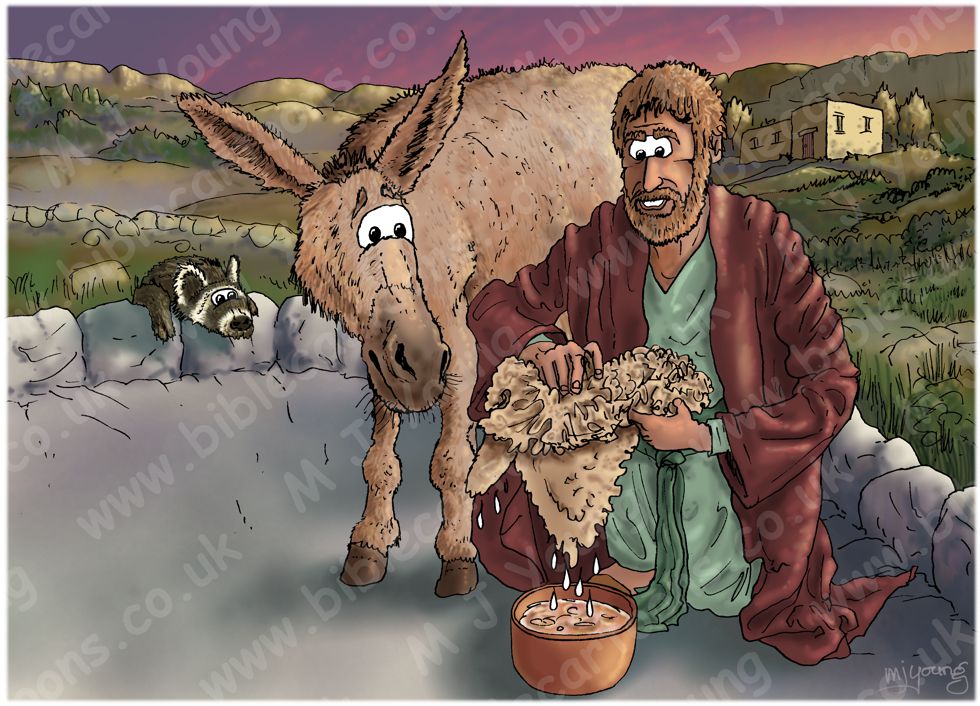


Bible Book: Judges
Bible Book Code: 0700603601
Scene no: 12 of 13
Bible Reference & Cartoon Description
Judges 6:36-38 (NLT)
36 Then Gideon said to God, “If you are truly going to use me to rescue Israel as you promised, 37 prove it to me in this way. I will put a wool fleece on the threshing floor tonight. If the fleece is wet with dew in the morning but the ground is dry, then I will know that you are going to help me rescue Israel as you promised.” 38 And that is just what happened. When Gideon got up early the next morning, he squeezed the fleece and wrung out a whole bowlful of water.
DRAWING NOTES:
TIME OF DAY:
Verse 38 tells us it is early morning.
LIGHTING NOTES:
The sun is just coming up, but is unseen in the East (right).
CHARACTERS PRESENT:
Gideon.
A donkey and a Marbled polecat (as seen in Scenes 04a, 04b, 05 & 06).
RESEARCH/ADDITIONAL NOTES:
This scene shows Gideon kneeling on his family threshing floor, wringing out a bowlful of water from a fleece. The divine sign would be if the fleece was wet with dew, but the floor was dry… which it was. Notice I have included the donkey & Marbled polecat which appear in previous scenes.
Here’s the scene without the figure of Gideon, or the animals in the foreground.
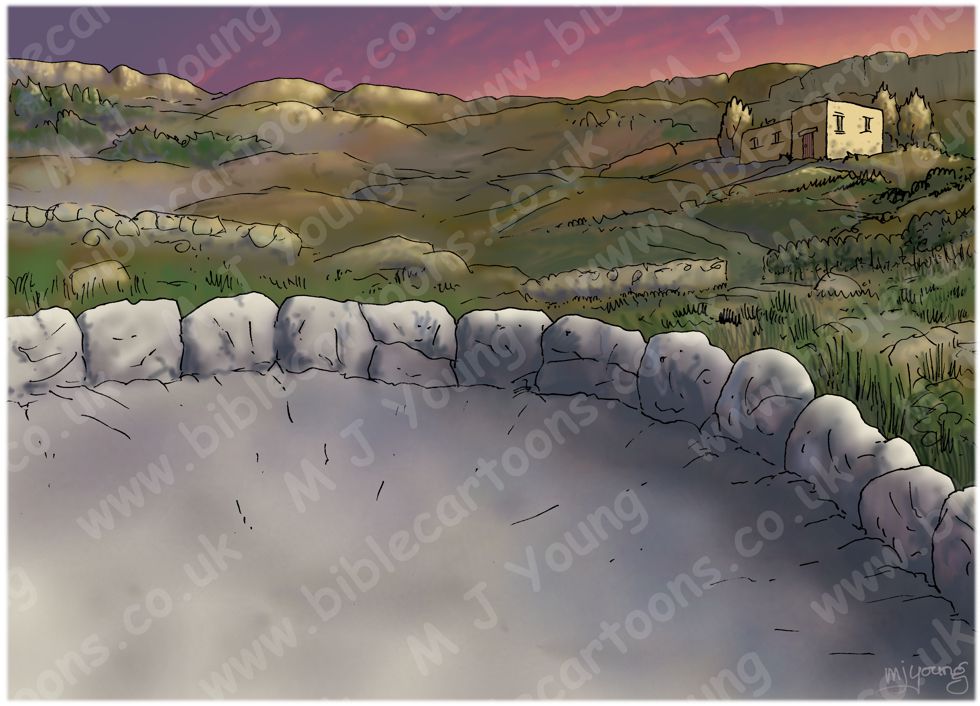
Background of Judges 06 – Gideon – Scene 12 – Wet fleece sign
Click on the colour bar below to view/buy this Background:
Background of Judges 06 – Gideon – Scene 12 – Wet fleece sign
A note about threshing floors.
In Bible times, a threshing floor was an outdoor, elevated usually circular area where farmers separated grain from chaff. A traditional threshing floor is usually made of hard-packed earth, smooth paved stone, or wood. Beyond its agricultural purpose, the threshing floor is a powerful spiritual metaphor for divine judgment, testing, and refinement, and is notably the specific site where King David built an altar that became the location of Solomon’s Temple.
“What Is a Threshing Floor Used For?
A threshing floor separates grain from chaff during the harvest season. Threshing has been an essential agricultural step since ancient times.
Farmers bring harvested grains to the threshing floor, typically a flat, open area. Then, they employ various methods to separate edible grain kernels from inedible chaff. One common technique involves spreading the talks, which contain both grain and chaff, across the floor’s surface. The farmers loosen grain from husks by beating the stalks with flails or driving animals over them; the applied force is called threshing. Heavier grains fall to the ground while lighter chaff is blown away.
Sometimes, the process includes manually winnowing the chaff. For example, the farmers might toss the mix into the air with wooden forks, allowing the wind to carry the chaff away, leaving the grain behind. Many times, the farmer burns the chaff, destroying it.
The threshing floor first serves a practical purpose: to ensure a bountiful grain yield. Beyond this function, the floor becomes a gathering place for farmers to collaborate during harvest season. Shared labour and community contribute to solidarity and fellowship among farmers and others involved in agriculture. Naturally extending from the size and use, threshing floors could be employed for social and religious gatherings, especially when seeking divine aid in the coming crop.
For these reasons, historically, the community set threshing floors in areas central to local, rural life. Further, the threshing floors appeared in farming folklore and art, such as songs and stories passed through generations to symbolize unity and hard work vital to farming communities.
Since biblical cultures relied upon farming, especially once Israel settled in the Promised Land, the threshing floor appears in Scripture. These references provide insight into Israel’s agricultural practices and become spiritual metaphors.”
[Source: https://www.biblestudytools.com/bible-study/topical-studies/what-bible-teach-us-when-it-talks-about-threshing-floor.html]
1. Key Biblical Stories and Locations
Solomon’s Temple Site: When a plague struck Israel because of King David’s sin, God commanded him to purchase the threshing floor of Araunah (or Ornan) the Jebusite to build an altar. This exact site on Mount Moriah later became the location where Solomon built the First Temple (2 Samuel 24, 2 Chronicles 3:1).
The Book of Ruth: Naomi instructed Ruth to go down to the threshing floor to uncover the feet of Boaz, a crucial custom that led to Boaz becoming their “kinsman-redeemer” (Ruth 3).
2. Spiritual Symbolism
Separation and Judgment: Threshing involved crushing the stalks and throwing the mixture into the wind. The valuable grain fell to the ground, while the useless chaff blew away. The New Testament uses this to symbolize Judgment Day, where God separates the righteous (wheat) from the wicked (chaff).
Refinement and Trials: Just as grain must endure pressure and separation to become useful, the “threshing floor” represents the spiritual trials and tests believers go through to remove impurities and draw closer to God.
3. Key Scripture References
Matthew 3:12: John the Baptist describes the Messiah: “His winnowing fork is in his hand, and he will clear his threshing floor, gathering his wheat into the barn and burning up the chaff with unquenchable fire.”
2 Samuel 24:18-25: The account of David buying Araunah’s threshing floor to halt the plague.
Hosea 13:3: The fleeting nature of the wicked is compared to “chaff swirling from a threshing floor”.
Bible Doctrine Notes
6:36-40 REVELATION, Signs (3.21M)
The Lord God uses signs, wonders and miracles in the physical, material world in order to bolster his people’s faith (see Exodus 4:1-9). Such signs, when joined with prayerful, reverent conversation with God reveal His power and presence with His people. In the case of Gideon, such signs signified divine patience with a young believer facing an uncomfortable, awe-inspiring task.
6:36-40 PRAYER, Will of God (5.52B)
Prayer seeks the certainty of obedience towards, and alignment with, God’s will. The Lord God can assure us that we are aligned with His will for our lives as we talk in prayer with Him. God’s assurance may not take the dramatic form Gideon’s did, but the Lord God responds to our need for confirmation of His call on our lives. (Compare Isaiah 7:11.)