Bible Cartoon: Judges 06 - Gideon - Scene 11 - Ram's horn call to arms
Click on Add to cart button below shopping cart.
Purchased Bible Cartoons do not have watermarks. Links to Cartoons provided on email once purchase is completed.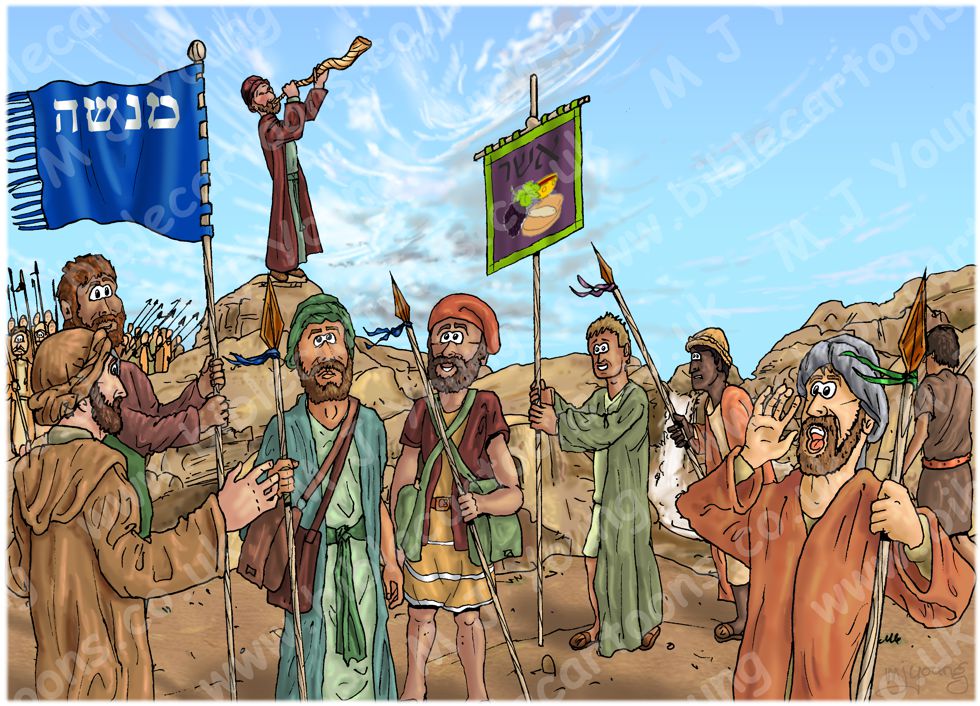


Bible Book: Judges
Bible Book Code: 0700603401
Scene no: 11 of 13
Bible Reference & Cartoon Description
Judges 6:34-35 (NLT)
34 Then the Spirit of the Lord took possession of Gideon. He blew a ram’s horn as a call to arms, and the men of the clan of Abiezer came to him. 35 He also sent messengers throughout Manasseh, Asher, Zebulun, and Naphtali, summoning their warriors, and all of them responded.
DRAWING NOTES:
TIME OF DAY:
Unspecified in the Bible narrative. I have set this scene in the mid morning.
LIGHTING NOTES:
The sun (unseen, high on the right (East)) illuminates this scene, casting shadows below and to the left of figures and objects.
CHARACTERS PRESENT:
Gideon is the man blowing a ram’s horn trumpet, standing on a rocky outcrop.
Various warriors from the tribes of Manasseh, Asher, Zebulun, and Naphtali.
RESEARCH/ADDITIONAL NOTES:
This is a fairly simple scene, showing Gideon standing on a rocky outcrop, blowing a ram’s horn trumpet, after the Spirit of the Lord took possession of him (see verse 34 above). This idea needs some explanation (see below).
I have included the purple and green tribal banner of Asher, held up by a young man in the middle of the picture. This banner design I devised some years ago, when designing all 12 of the banners for the 12 sons of Jacob-Israel. I haven’t created a tribal banner for the Manasseh tribe, so have simply created a blue flag/standard with white Hebrew text which reads “Manasseh”.
Here’s the scene without the figures.
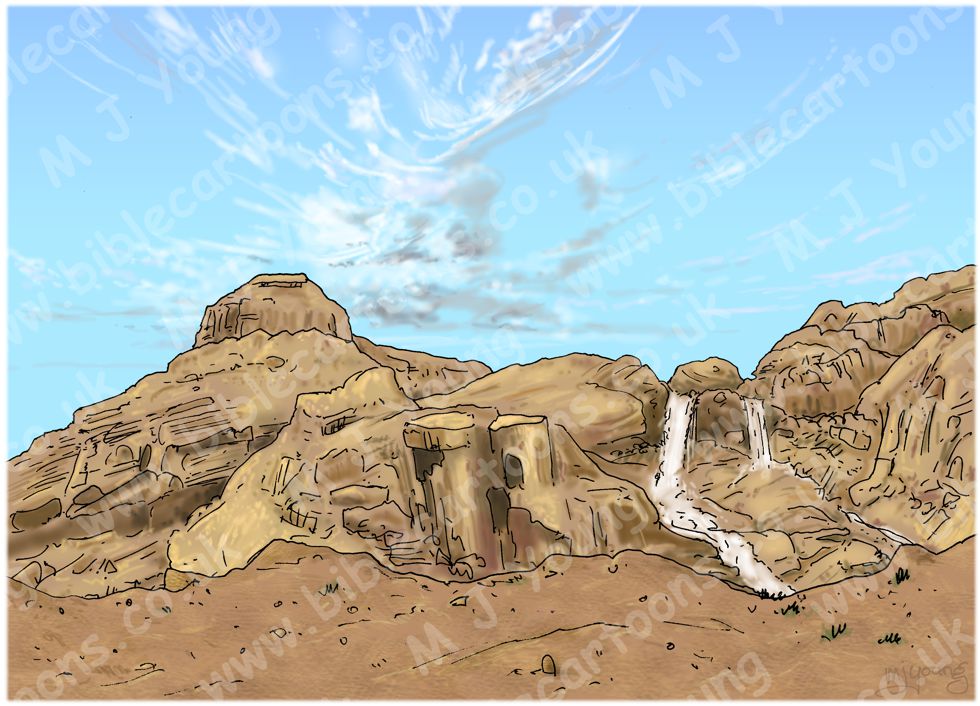
Background of Judges 06 – Gideon – Scene 11 – Ram’s horn call
Click on the colour bar below to view/buy this Background:
Background of Judges 06 – Gideon – Scene 11 – Ram’s horn call to arms
Explaining the phrase “the Spirit of the Lord took possession of Gideon”.
Judges 6:34 states that, “the Spirit of the Lord took possession of Gideon”, which at first glance sounds a little sinister! However, the phrase means God’s divine power overwhelmed Gideon’s natural fear and inadequacy, which is a much nicer interpretation! Instead of hiding, Gideon was supernaturally equipped with courage and leadership to rally an army of Israelites against their oppressors, the Midianites. The phrase holds several layers of meaning:
1. Literal Translation: “The Spirit Clothed Himself with Gideon”.
In the original Hebrew, the text reads “ruach Yahweh labshah eth-Gid’on”, which literally translates to “the Spirit of the LORD clothed Himself with Gideon”. This paints a striking picture: Gideon was not the one using the Spirit as a tool, but rather the Holy Spirit was using Gideon as a garment or vessel to accomplish His will.
2. Transformation from Coward to Leader.
Earlier in the chapter, Gideon was timid, threshing wheat in a winepress to hide it from enemy raiders, and expressing deep feelings of inadequacy. When the Spirit “took possession” of him, it represented a sudden, radical transformation. He went from a reluctant, fearful person into a bold, authoritative military leader capable of uniting some of the tribes of Israel into a fighting force. Bearing in mind the long years of hardship the Hebrew people had been suffering, this was no small feat.
3. Old Testament Context.
In the Old Testament, the Holy Spirit did not permanently dwell inside every believer as He does in the New Testament. Instead, the Spirit would “come upon” or “clothe” specific individuals temporarily, giving them supernatural strength, wisdom, or courage for a specific, urgent mission (such as leading a battle or prophesying).
4. A Call to Action.
The immediate result of the Spirit taking possession of Gideon was that he blew a ram’s horn (a shofar) and summoned his clan to arms. The Spirit’s empowerment gave Gideon the sudden ability to unite a fractured, terrified people into a functional army.
Ultimately, this verse underscores the biblical theme that God equips the unlikely. It shows that victory relies not on human strength or worldly advantages, but entirely on the empowering presence of God.