Bible Cartoon: Judges 06 - Gideon - Scene 04a - Angel of the Lord
Click on Add to cart button below shopping cart.
Purchased Bible Cartoons do not have watermarks. Links to Cartoons provided on email once purchase is completed.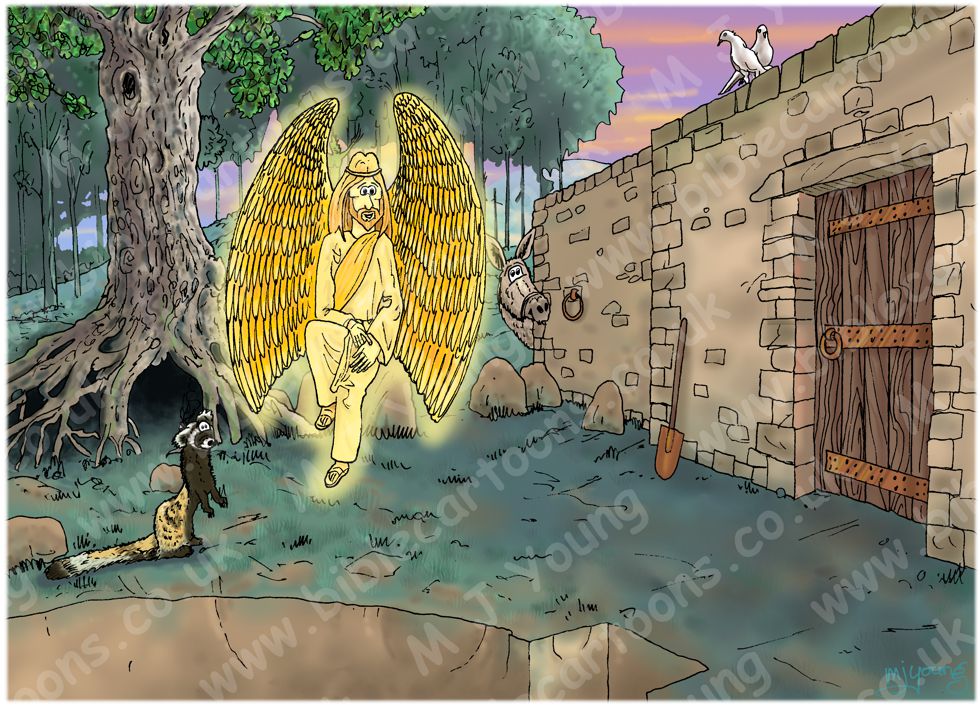


Bible Book: Judges
Bible Book Code: 0700601101
Scene no: 4a of 13
Bible Reference & Cartoon Description
Judges 6:11a (NLT)
Then the angel of the Lord came and sat beneath the great tree at Ophrah, which belonged to Joash of the clan of Abiezer. [Gideon son of Joash was threshing wheat at the bottom of a winepress to hide the grain from the Midianites.]
DRAWING NOTES:
TIME OF DAY:
Unspecified in the Bible narrative. I have set this scene just before sunrise.
LIGHTING NOTES:
The glow on the horizon from the right (East) is the pre-dawn sun, which creates feint highlights on the landscape and figures and shadows cast below and to their left.
CHARACTERS PRESENT:
The angel of the lord, a Marbled Polecat, a donkey and two white doves (emblematic of the Holy Spirit).
RESEARCH/ADDITIONAL NOTES:
This scene occurs just before the dawn and shows the angel of the Lord sitting beneath the great tree at Ophrah (verse 6:11a above).
The Great Tree of Ophrah is a terebinth tree (or oak) which served as a significant site for divine commissioning, representing God meeting a fearful Gideon during the Midianite oppression. The tree is often seen as a place of divine revelation and a witness to God calling an unlikely deliverer. Here was the physical presence of the divine God, appearing suddenly in the mundane aspects of life, using His power to turn fear into courage. The Hebrew word alah (terebinth) refers to a tree that grows wide with thick branches, often producing fruit and creating low shade, rather than a tall oak. The Great Tree of Ophrah was located in the town of Ophrah, which was in the territory of the clan of Abiezer, within the tribe of Manasseh in northern Israel.
Here’s the scene without the angel or animals.
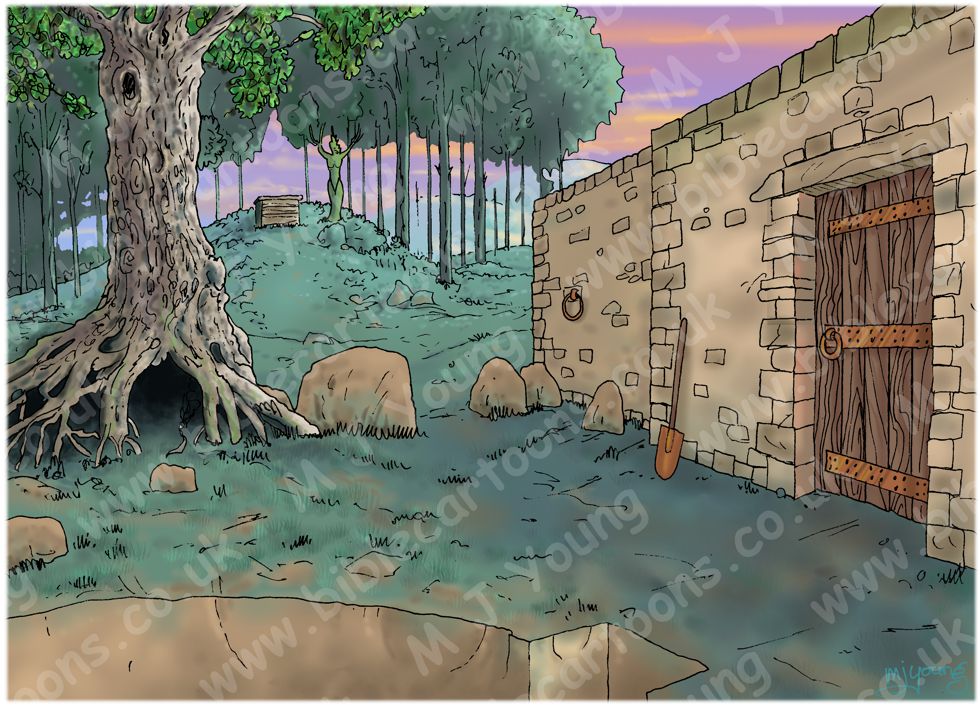
Background of Judges 06 – Gideon – Scene 04a – Angel of the Lord
Click on the colour bar below to view/buy this Background:
Background of Judges 06 – Gideon – Scene 04a – Angel of the Lord
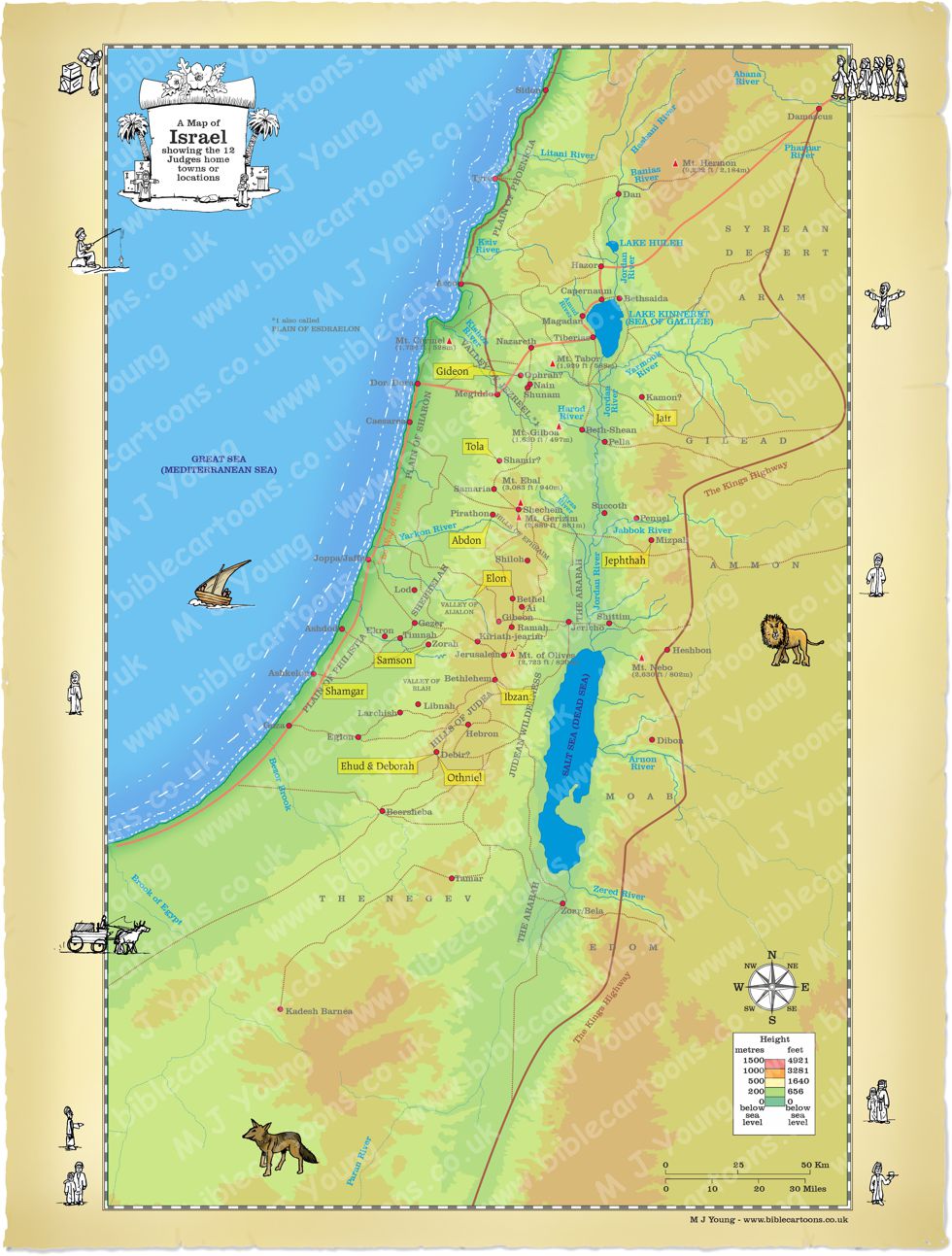
Map - The 12 Judges home towns or locations
Click yellow bar below to see Maps: The 12 Judges home towns and locations, with download & purchase options:
Map – The 12 Judges home towns or locations
The Manasseh Hills or hill country of Manasseh, directly derived from Hebrew: Menashe Heights which is a geographical region in northern Israel, located on the Carmel Range, between Mount Carmel and Mount Amir/Umm al-Fahm. While Manasseh hill country (Ramat Menashe) is part of the mountain range, it is just 656 feet (200 metres) above sea level on average, and peaks at 1312 feet (400 metres). The plateau is bordered by the Jezreel Valley to the northeast, Wadi Milh (the Yokne’am Stream) to the northwest, Wadi Ara to the southeast, and the Nadiv Valley to the southwest.
[Source: https://en.wikipedia.org/wiki/Manasseh_Hills]
Geologically the hills are characterized by hard Cenomanian-Turonian limestone and dolomite, alongside soft Eocene and Senonian rocks, featuring rugged terrain, karstic features, and terra rosa soil pockets. The area is heavily influenced by the Umm el-Fahm anticline and has significant water resources, with natural springs and a landscape often described as natural terraces.
Who is the Angel of the Lord?
“The precise identity of the angel of the Lord is not given in the Bible; however, there are many important clues that indicate the angel of the Lord is a unique being, separate from the other angels. Here are some instances of the angel of the Lord showing up in Scripture:
• He finds Hagar in the wilderness and gives her a promise concerning her son, Ishmael (Genesis 16:7–12; cf. 21:17–18).
• He stops Abraham from sacrificing Isaac (Genesis 22:11–18).
• He appears to Moses “in flames of fire from within a bush” (Exodus 3:2).
• He delivers a message to wayward Israel (Judges 2:1–4).
• He commissions Gideon and performs a miracle for him (Judges 6:11–24).
• He brings a plague on Israel during David’s time (2 Samuel 24:15–17).
• He appears in a vision of the prophet Zechariah (Zechariah 1:11–13; cf. 3:1–10).
In various passages, the angel of the Lord speaks as God, identifies Himself with God, and exercises the responsibilities of God. In several of these appearances, those who saw the angel of the Lord feared for their lives because they had “seen God” (Judges 13:22; cf. Judges 6:22). Therefore, we can say that, in at least some instances, the angel of the Lord is a theophany, an appearance of God in physical form.
The appearances of the angel of the Lord cease after the incarnation of Christ. Angels are mentioned numerous times in the New Testament, but “the angel of the Lord” is never mentioned in the New Testament after the birth of Christ. One possible difficulty is that the angel who appears to Joseph in a dream in Matthew 1:24 is called “the” angel of the Lord. However, this angel is clearly the same one appearing in verse 20, which calls him “an” angel. Matthew is simply referencing the same angel he had just mentioned. There is also some confusion regarding Matthew 28:2, where the KJV says “the angel of the Lord” descended from heaven and rolled the stone away from Jesus’ tomb. Here, it is important to note that the original Greek has no article in front of the word for “angel”; it could be “the angel” or “an angel,” but the article must be supplied by the translators. Other translations besides the KJV say it was “an angel,” which is the better wording.
It is possible that appearances of the angel of the Lord represent the Son of God taking on temporary human form—a pre-incarnate appearance of Jesus Christ. Jesus declared Himself to be existent “before Abraham” (John 8:58), so it makes sense that He would be active and could manifest in the world. Whatever the case, whether the angel of the Lord was a pre-incarnate appearance of Christ (a Christophany) or an appearance of God the Father (a theophany), it is likely that “the angel of the Lord” was, in most cases, a physical appearance of God.”
[Source: https://www.gotquestions.org/angel-of-the-Lord.html]
Columba livia domestica (white dove). The Barbary dove, ringed turtle dove, ringneck dove, ring-necked turtle dove, or ring dove (Streptopelia risoria) is a domestic member of the dove and pigeon family (Columbidae).
Vormela peregusna (Marbled Polecat)
Vormela peregusna (The marbled polecat) is a small mustelid belonging to the subfamily Ictonychinae. It is the only living member of the genus Vormela. Marbled polecats are generally found in the drier areas and grasslands of southeastern Europe to western China. Like other members of the Ictonychinae, it can emit a strong-smelling secretion from anal sacs under the tail when threatened.
Ranging in length from 29–35 cm (head and body), the marbled polecat has a short muzzle and very large, noticeable ears. The limbs are short and claws are long and strong. While the tail is long, with long hair, the overall pelage is short. Black and white mark the face, with a black stripe across the eyes and white markings around the mouth. Dorsally, the pelage is yellow and heavily mottled with irregular reddish or brown spots. The tail is dark brown with a yellowish band in the midregion. The ventral region and limbs are a dark brown.20 Females weigh from 295 to 600 g (10.4 to 21.2 oz) and males from 320 to 715 g (11.3 to 25.2 oz).
Marbled polecats are known to eat ground squirrels, Libyan jirds (Meriones libycus), Armenian hamsters (Cricetulus migratorius), voles, Palestine mole-rats (Spalax lecocon ehrenbergi), house mice (Mus musculus), and other rodents, small hares, birds, lizards, fish, frogs, snails, and insects (beetles and crickets), as well as fruit and grass.22262723 They are also recorded as taking small domestic poultry such as chickens and pigeons, as well as stealing smoked meat and cheese.
The marbled polecat was once sought for its fur, generally known as “fitch” or more specifically, “perwitsky” in the fur trade.
{Source: https://en.wikipedia.org/wiki/Marbled_polecat]
Bible Doctrine Notes
6:11-40 EVIL AND SUFFERING, God’s Present Help (2.33D)
God alleviated Israel’s suffering by calling Gideon to be a judge. Gideon was looking for miraculous divine intervention, unexpectedly (for Gideon!) the Lord God sent him to be the relief the Israelites wanted from the marauding Midianites. Similarly, we can not always expect divine intervention to lead us out of trouble, instead we must be ready to answer God’s call in obedience action. In so doing, we express our faith in God’s help, via us. God often chooses to use us to achieve his ends, rather than show his miraculous power. He can use his divine, miraculous power, but often chooses to work His miracles through ordinary, but committed, obedient, human beings.
6:11-24 REVELATION, Messengers (3.21G)
Gideon was discouraged and confused regarding God’s actions in Israel’s current difficulties with the Midianites. He had only heard of God power from parents and teacher, he had no first hand experience himself. Gideon felt that God had abandoned his people, since his generation had not seen God’s saving actions.
Gideon responded with surprise to the messenger of God, but as though the messenger were God himself, fearing for his (Gideon’s) life after seeing the angelic messenger face to face.
6:11-24 PRAYER, Will of God (5.52B)
God’s usual response to Israel’s cry for help was to send a deliverer (or Judge).Gideon’s calling came in the form of a dialogue with the Creator. Gideon honestly voiced his frustration and sense of abandonment to God. He then claimed to be unqualified to be the divinely appointed deliverer of Israel. God provided a visible sign to reassure Gideon and then called Gideon to action. Gideon does not provide a model of how we should always pray to God. However, his prayer dialogue does show us that God will listen to our complaints, our frustrations, and our sense of inadequacy.