Bible Cartoon: Genesis 02 - Adam and Eve - Scene 06 - The making of Eve (Modest version)
Click on Add to cart button below shopping cart.
Purchased Bible Cartoons do not have watermarks. Links to Cartoons provided on email once purchase is completed.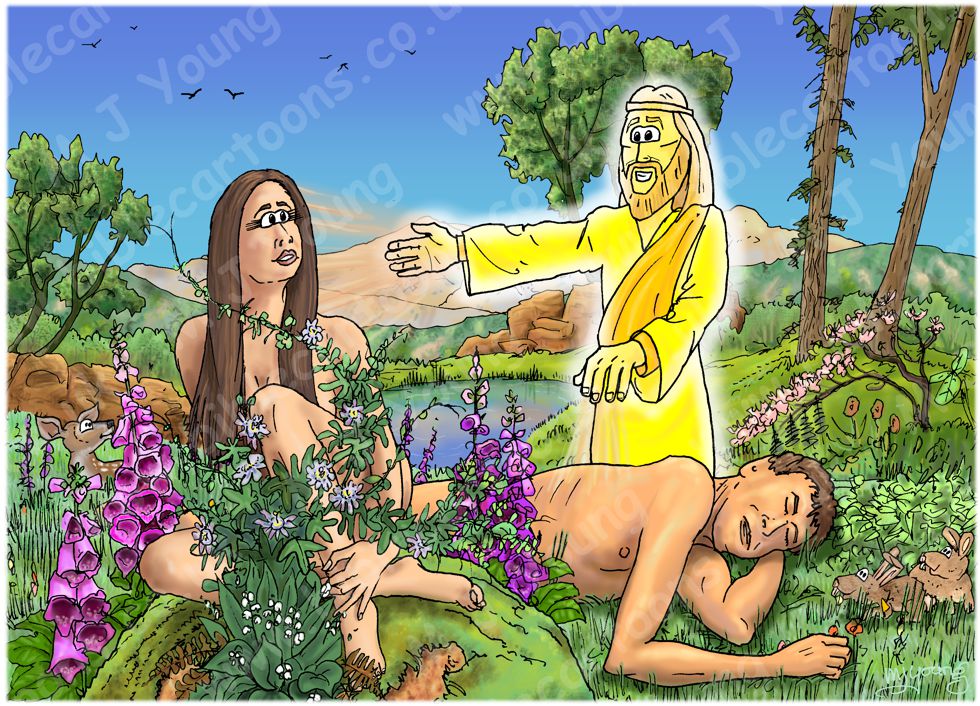



Bible Book: Genesis
Bible Book Code: 0100202102
Scene no: 6 of 6
Bible Reference & Cartoon Description
Genesis 2:21-25 (NLT)
21 So the Lord God caused the man to fall into a deep sleep. While the man slept, the Lord God took out one of the man’s ribs [1] and closed up the opening. 22 Then the Lord God made a woman from the rib, and he brought her to the man.
23 “At last!” the man exclaimed.
“This one is bone from my bone,
and flesh from my flesh!
She will be called ‘woman,’
because she was taken from ‘man.’”
24 This explains why a man leaves his father and mother and is joined to his wife, and the two are united into one. 25 Now the man and his wife were both naked, but they felt no shame.
[1]
Or, took a part of the man’s side.
DRAWING NOTES:
TIME OF DAY:
Unspecified in the Bible narrative. Daytime.
LIGHTING NOTES:
The sun (unseen, high in the sky) illuminate this scene, casting shadows below figures and objects. There is a glow of power around the figure of the Lord God.
CHARACTERS PRESENT:
The Lord God. Adam (asleep) and Eve, sitting on a boulder.
RESEARCH/ADDITIONAL NOTES:
There are two versions of this scene:
01) (Previous page) Genesis 02 – Adam and Eve – Scene 06 – The making of Eve. This is the original version.
02) (This page) Genesis 02 – Adam and Eve – Scene 06 – The making of Eve (Modest version). In this version I have added some additional plants (details of which see below), strategically placed to cover up more of the naked body of Eve. I added this version in deference to more sensitive viewers/customers.
This scene shows the Lord God standing in the Garden in Eden. He has caused the man Adam to fall into a deep sleep (see verse 21). From Adam’s side God makes Eve, who is sitting on a moss covered coarse-grained red granite boulder. I have drawn my usual glow of power around the figure of the Lord God, and added some power light beams coming from his hands to illustrate his creative actions: his left hand is over Adam (removing the flesh from his side) & his right hand is shaping Eve.
I am very pleased with the way the Foxglove flowers came out in this picture! (Details below).
Here is the scene without the figures in the foreground.
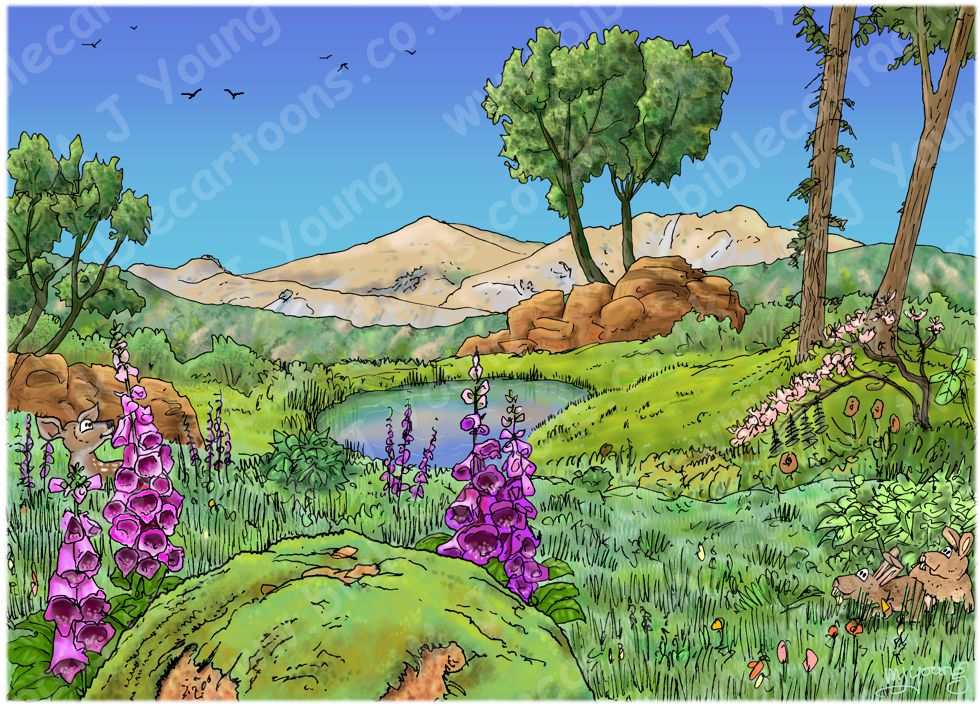
Background of Genesis 02 – Adam and Eve – Scene 06 – The making of Eve (Modest version)
Click on the colour bar below to view/buy this Background:
Background of Genesis 02 – Adam and Eve – Scene 06 – The making of Eve (Modest version)
Digitalis purpurea, the foxglove or common foxglove, is a toxic species of flowering plant in the plantain family Plantaginaceae, native to and widespread throughout most of temperate Europe.
Digitalis purpurea is an herbaceous biennial or short-lived perennial plant. The leaves are spirally arranged, simple, 3.9–13.8 inches (10–35 cm) long and 2–5 inches (5–12 cm) broad, and are covered with gray-white pubescent and glandular hairs, imparting a woolly texture. The foliage forms a tight rosette at ground level in the first year.
The flowering stem develops in the second year, typically 3.3–6.6 feet (1–2 metres) tall, sometimes longer. The flowers are arranged in a showy, terminal, elongated cluster, and each flower is tubular and pendent. The flowers are typically purple, but some plants, especially those under cultivation, may be pink, rose, yellow, or white. The inside surface of the flower tube is heavily spotted. The flowering period is early summer, sometimes with additional flower stems developing later in the season. The plant is frequented by bees, which climb right inside the flower tube to gain the nectar within.
Digitalis purpurea has a native range that spans across several countries in Western Europe and North Africa.
Due to the presence of the cardiac glycoside digitoxin, the leaves, flowers and seeds of this plant are all poisonous to humans and some animals and can be fatal if ingested.
[Source: https://en.wikipedia.org/wiki/Digitalis_purpurea]
Notes on additional plants in this picture.
This version of the picture has two other pants in the foreground, covering Eve’s body, details as follows.
The flower most commonly associated with Eve is Convallaria majalis (aka the Lily of the Valley, Eve’s Tears).
According to Christian legend and folklore the white, bell-shaped flowers are said to represent these tears of repentance and sadness, that sprang from the tears that Eve, shed upon being expelled from the Garden of Eden by the Lord God. While other lily varieties are sometimes mentioned in similar contexts, the Lily of the Valley is the primary flower linked to the story of Eve’s exile.
Beyond this folklore, the flower symbolizes purity, humility, and the “return to happiness,” according to Victorian flower language. Interestingly, and also associated with tears, the same flowers are representative of the tears of the Virgin Mary (Jesus’s earthly mother), and sometimes referred to as “Our Lady’s Tears”.
Convallaria majalis is a herbaceous perennial plant that often forms extensive colonies by spreading underground rhizome stems. New upright shoots are formed at the ends of stolons in summer, which grow in the spring into new leafy shoots that still remain connected to the other shoots under ground.
The stems grow to 6–14 inches (15–35 centimetres) tall, with two (or rarely three) leaves which are approximately 2–8 inches (5–20 centimetres) long and 1–3 inches (3–7 centimetres) broad.
The flowering stems have a one-sided raceme of six to twelve pendulous flowers on the upper part of the stem. The flowers have six white tepals (except for the species Convallaria majalis var. “Rosea”, which has pink tepals), fused at the base to form a bell shape with reflexed tips that are 0.2–0.4 inches (5–10 millimetres) in diameter, and are sweetly scented.
The fruit is a poisonous small orange-red berry that is approximately 0.2–0.3 inches (5–7 millimetres) in diameter that contains an average of 3.9 large whitish to brownish seeds that dry to a clear translucent round bead 0.04–0.12 inches (1–3 millimetres) wide.
All parts of the plant are potentially poisonous, including the red berries which may be attractive to children. If ingested, the plant can cause abdominal pain, nausea, vomiting, and irregular heartbeats.
[Suorce: https://en.wikipedia.org/wiki/Lily_of_the_valley]
Passiflora caerulea (aka the blue passionflower, bluecrown passionflower or common passion flower).
Belonging to the flowering plant family Passifloraceae, it is native to South America and has been introduced elsewhere. It forms a vigorous, deciduous or semi-evergreen tendril-bearing vine growing to 33 feet (10 metres) or more. Its leaves are palmately lobed, and its fragrant flowers are blue-white with a prominent fringe of coronal filaments in bands of blue, white, yellow, and brown. The flower is complex, about 4 inches (10 centimetres) in diameter, with the five sepals and petals similar in appearance, whitish in colour, surmounted by a corona of blue or violet filaments, then five greenish-yellow stamens and three purple stigmas.
The fruit is an oval orange-yellow berry, 2 1/4 inches (6 centimetres) long by 1 1/2 inches (4 centimetres) in diameter, containing between 10 to 35 seeds.
[Source: https://en.wikipedia.org/wiki/Passiflora_caerulea]
Bible Doctrine Notes
2:21-25 HUMANITY, Marriage (2.43D)
The first song recorded in the Bible was Adam’s joyful celebration of God’s gift to him of Eve, his wife. Ideal marriage can still produce this rejoicing. From God’s very first acts of creation, unity within marriage relationships is set forth in terms of oneness. The absence of shame in this relationship points to the goodness of this whole relationship, including the gift of sex. Although the first couple had no physical parents the intention that marriage should take precedence over parent-child ties is clearly stated. The newly created relationship of marriage becomes the primary one.
2:24 FAMILY, One Flesh (5.82B)
The Hebrew and Greek words usually translated “flesh” refer to the whole person, not just the physical or sensual aspects of human nature. Becoming one flesh is established through sexual union, but the implications of the term are more than just sexual. That union creates a psychological and spiritual interrelationship in which both persons establish a bond that is more than merely physical. The one flesh union establishes a bonding of personhood which is fundamental to marriage permanence. The one flesh union does not destroy the personhood of either partner but celebrates their self-giving to each other in love; this concept has a mystical quality, but it celebrates the depth of the marriage relationship. (See Matthew 19:6; Mark 10:6-9; Ephesians 5:28-31).