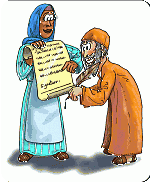
Nehemiah, son of Hacaliah character design sheet
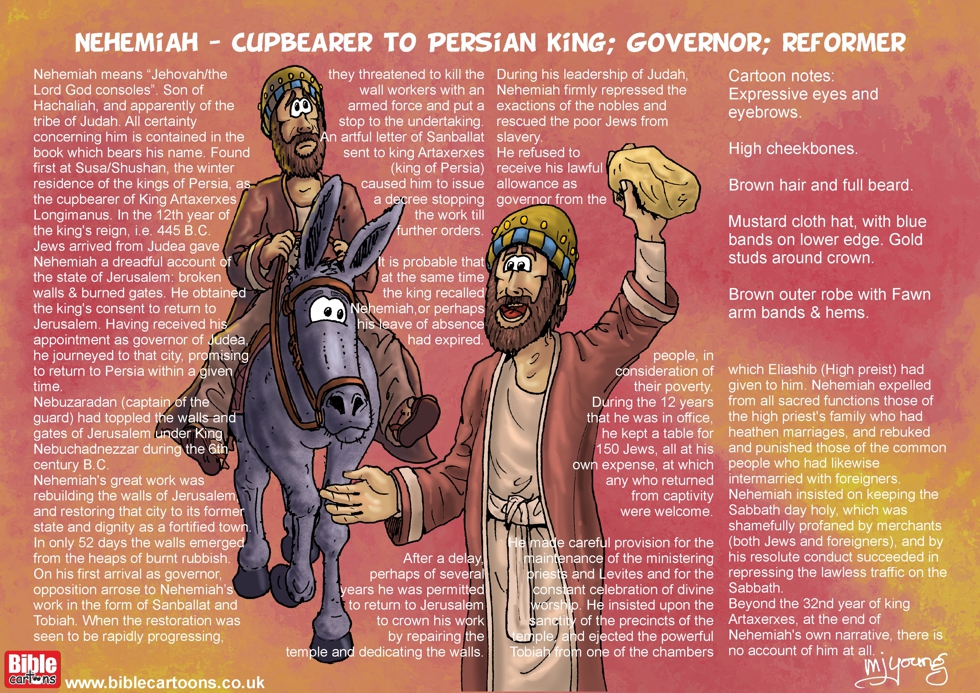
This is my character sheet, or design specification, for Nehemiah, the son of Hacaliah. The purpose of this sheet is to keep a record of the attributes or characteristics of my drawing, so that I can draw a similar-looking cartoon in all future scenes showing Nehemiah.
I first drew my version of Nehemiah in January 2025, with the “Nehemiah 01 – Nehemiah’s Prayer – Scene 01 – Mourning for Jerusalem” Bible Cartoon picture. I try to maintain the same facial features, colouring and clothing style, so that the figure is recognizably that of Nehemiah, even when months or years have elapsed between drawings.
Personal History
Nehemiah means “Jehovah/The Lord God consoles” or “comforted of Yahweh”.
“Governor of the Jews. The genealogy of Nehemiah is unknown, except that he was the son of Hacaliah (Neh. 1:1) and brother of Hanani (Neh. 7:2; cf. Neh. 1:2). All that we know for certain of Nehemiah is found in the book bearing his name.
He first appears at Susa as cupbearer to King Artaxerxes Longimanus (Neh. 1:11-2:1), about 446 b.c. In that year he was informed of the deplorable condition of his countrymen in Judea, and determined to go to Jerusalem to endeavor to better their condition.
Three or four months later he presented his request to the king to be allowed to go and rebuild Jerusalem. His royal master granted his request and appointed him Tirshathá, “governor.” Accompanied by a troop of cavalry and letters from the king to the different governors through whose provinces he was to pass, as well as to Asaph, the keeper of the king’s forests (to supply him with timber), he started upon his journey, being under promise to return to Persia within a given time (Neh. 2:1-10).
Nehemiah, without a moment’s unnecessary delay, began the restoration of the city walls, which was accomplished in the wonderfully short time of fifty-two days (Neh. 6:15), 444 b.c. In this he was opposed by Sanballat and Tobiah, who not only poured out a torrent of abuse and contempt upon all engaged in the work but actually made a conspiracy to fall upon the builders with an armed force and put a stop to the undertaking. The project was defeated by the vigilance and prudence of Nehemiah. This armed attitude was continued from that day forward (Neh. 4). He also reformed abuses, redressed grievances (Neh. 5), introduced law and order (Neh. 7), and revived the worship of God (Neh. 8). Various strategems were then resorted to in order to get Nehemiah away from Jerusalem and, if possible, take his life. But that which most nearly succeeded was the attempt to bring him into suspicion with the king of Persia, as if Nehemiah intended to set himself up as an independent king as soon as the walls were completed. The artful letter of Sanballat so far wrought upon Artaxerxes that he issued a decree stopping the work until further orders (Ezra 4:21).
In these reforms Nehemiah enjoyed the cooperation of Ezra, who had preceded him to Jerusalem, and who is named as taking a prominent part in public affairs (Neh. 8:1, 9, 13; Neh. 12:36). Nehemiah refused to receive his lawful allowance as governor during the whole term of his office because of the people’s poverty but entertained for twelve years, at his own cost, 150 Jews and welcomed any who returned from captivity (Neh. 13:14-18).
Nehemiah, after twelve years’ service, returned to Babylon (Neh. 5:14; Neh. 13:6), 434 b.c. It is not known how long he remained there, but “after some time” he obtained permission to again visit Jerusalem, where his services were needed because of new abuses that had crept in. When he arrived, Nehemiah enforced the separation of the mixed multitude from Israel (Neh. 13:1-3), expelled Tobiah the Ammonite from the Temple chamber (Neh. 13:4-9), and made better arrangements for the support of the Temple service (Neh. 13:10-14) and for the observance of the Sabbath (Neh. 13:15-22). His last recorded act was an effort to put an end to mixed marriages, which led him to drive away a son of Joiada, the high priest, because he was son-in-law to Sanballat the Horonite (Neh. 13:23-28). It is supposed that Nehemiah remained in Jerusalem until about 405 b.c., toward the close of the reign of Darius Nothus, mentioned in Neh. 12:22. The time and place of his death is unknown. To Nehemiah is credited the authorship of the book that bears his name.
Nehemiah’s character seems almost without a blemish. He was a man of pure and disinterested patriotism, willing to leave a position of wealth, power, and influence in the first court of the world and share the sorrows of his countrymen. He was not only noble, high-minded, and of strict integrity, but he was also possessed of great humility, kindness, and princely hospitality. In nothing was he more remarkable than in his piety, walking before his God with singleness of eye, seeking divine blessing and cooperation in prayer, and returning thanks to him for all his successes.”
[Source: New Unger’s Bible Dictionary]
Return to BC Encylopaedia Index page