Bible Cartoon: Judges 06 - Gideon - Scene 08 - Night raid on Baal's altar
Click on Add to cart button below shopping cart.
Purchased Bible Cartoons do not have watermarks. Links to Cartoons provided on email once purchase is completed.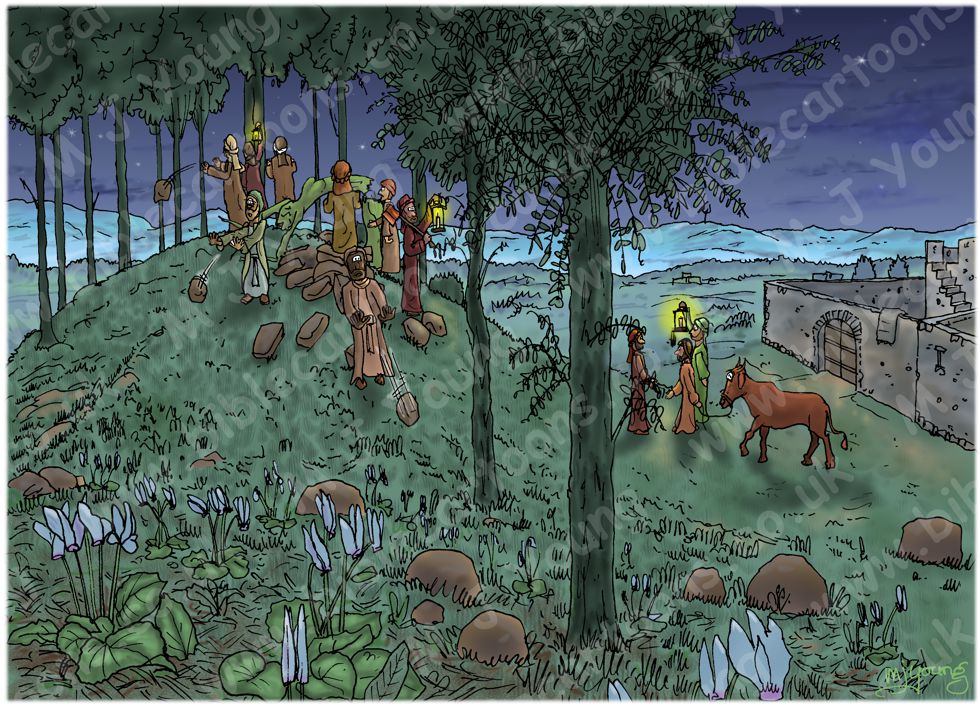


Bible Book: Judges
Bible Book Code: 0700602501
Scene no: 8 of 13
Bible Reference & Cartoon Description
Judges 6:25-27 (NLT)
25 That night the Lord said to Gideon, “Take the second bull from your father’s herd, the one that is seven years old. Pull down your father’s altar to Baal, and cut down the Asherah pole standing beside it. 26 Then build an altar to the Lord your God here on this hilltop sanctuary, laying the stones carefully. Sacrifice the bull as a burnt offering on the altar, using as fuel the wood of the Asherah pole you cut down.”
27 So Gideon took ten of his servants and did as the Lord had commanded. But he did it at night because he was afraid of the other members of his father’s household and the people of the town.
DRAWING NOTES:
TIME OF DAY:
Night.
LIGHTING NOTES:
Feint light from three lanterns & the stars illuminate this scene.
CHARACTERS PRESENT:
Gideon and ten of his servants. Gideon’s father’s second bull.
RESEARCH/ADDITIONAL NOTES:
Gideon is the man wearing a dark red-brown outer robe, standing on the hill, carrying a lantern. He has a bronze axe on his shoulder, which he has just used to chop down the green Asherah pole by the side of Baal’s alter, on top of the hill. The rest of the people present are his servants (see verse 27), one of which is leading Gideon’s father’s second bull up the hill, to be sacrificed.
The grassy hill is covered in Cyclamen persicum (the Persian cyclamen, see notes below).
Here’s the scene without the figures or bull.
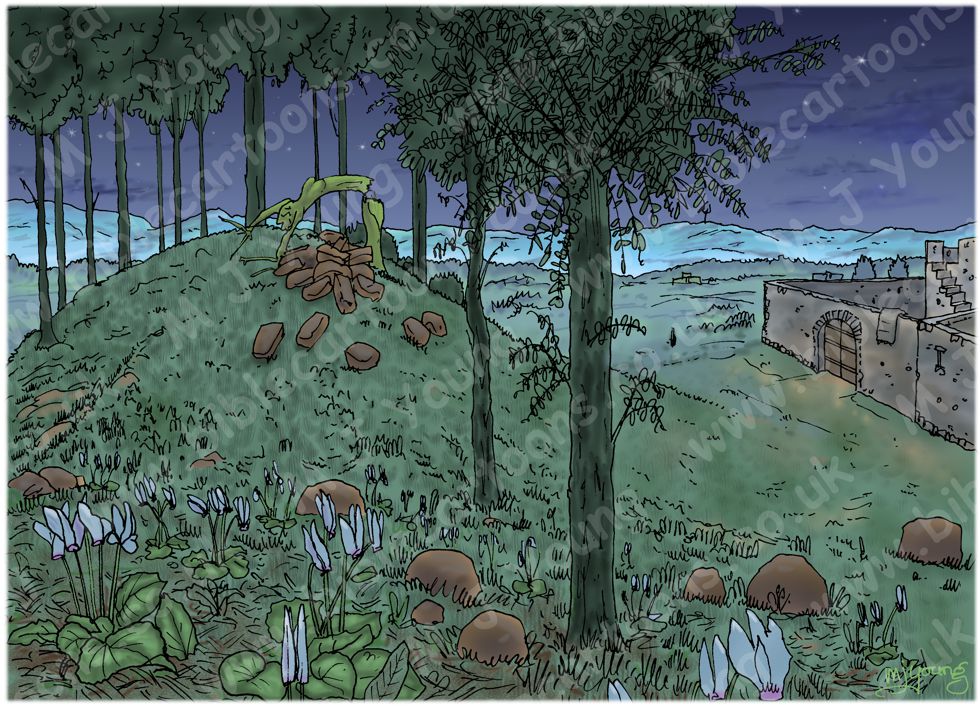
Background of Judges 06 – Gideon – Scene 08 – Night raid on Baal’s altar
Click on the colour bar below to view/buy this Background:
Background of Judges 06 – Gideon – Scene 08 – Night raid on Baal’s altar
Cyclamen persicum
The flowering plants in my picture are Cyclamen persicum (aka the Persian cyclamen), which is a species of flowering herbaceous perennial plant growing from a tuber, native to rocky hillsides, shrubland, and woodland up to 1,200 m (3,900 ft) above sea level, from south-central Turkey to the Levant.
Cyclamen persicum is a perennial, herbaceous plant that reaches heights of about 13 inches (32 centimetres). Wild plants have heart-shaped, fleshy leaves, up to 6 inches (14 centimetres) usually green with lighter markings on the upper surface. The leaf underside may be pale green or reddish. The leaf margin is slightly thickened and usually serrated. As a storage and persistence organ, C. persicum forms a perennial hypocotyl tuber. It arises solely through a thickening of the hypocotyl, the shoot axis area between the root neck and the first cotyledon. The rounded, slightly flattened tuber is about 1.6 to 5.9 inches (4 to 15 centimetres) or more in diameter. It is of corky consistency. The roots spring from the underside, and the tops of the spirally arranged, long-stalked leaves of the plant spring from the top.
Flowers bloom from winter to spring and have 5 small sepals and 5 upswept petals, usually white to pale pink with a band of deep pink to magenta at the base. Cyclamen carry on individual stems standing flowers that hang down but whose petals are bent strongly upwards. In the species, flowers are sweetly scented, but the scent has been lost in cultivated forms.
[Source: https://en.wikipedia.org/wiki/Cyclamen_persicum]
Who was Baal?
According to some versions of Canaanite mythology, Baal was the son of Dagon; other accounts make him out to be a son of El, the chief god, and Asherah, the goddess of the sea.
The Hebrew Bible includes use of the term in reference to various Levantine deities, often with application towards Hadad, who was decried as a false god. The plural is Baal is Baalim. In the Hebrew Bible, Baal appears frequently as a foreign or rival deity. While Baal was a general deity, local areas worshipped specific manifestations, such as Baal-Peor (see Numbers 25:3) or Baal-Berith (see Judges 8:33). The Old Testament views Baal as the chief rival to God.
Before the Hebrews entered the Promised Land, the Lord God warned against worshiping Canaan’s gods (Deuteronomy 6:14-15), but Israel turned to idolatry anyway. During the reign of Ahab and Jezebel, at the height of Baal worship in Israel, God directly confronted the paganism through His prophet Elijah, who famously confronted 450 prophets of Baal on Mount Carmel (see 1 Kings 18), demonstrating God’s power over the rain and elements.
In Matthew 12:27, Jesus calls Satan “Beelzebub,” linking the devil to Baal-Zebub, a Philistine deity (2 Kings 1:2). The Baalim of the Old Testament were nothing more than demons masquerading as gods, and all idolatry is ultimately devil-worship (see 1 Corinthians 10:20).
What is an Asherah polel?
An Asherah pole was a sacred wooden object, often a carved tree or post, representing the Canaanite goddess Asherah, consort of Baal and mother of the gods. Asherah was revered as a mother goddess, often called “Mother of the Gods,” “She Who Walks on the Sea,” and “Consort of El”. She was sometimes associated with lions and serpents. Used in ancient Canaanite and Israelite worship, these symbols represented fertility and life, often placed near altars and on high places. The Hebrew Bible frequently condemns them, leading to their destruction by reformers.
In my picture the pole has a greenish, vaguely female shape.
Worship of Asherah, alongside Baal, was common in Israel and Judah, particularly during the premonarchic and divided monarchy periods. In Exodus and Deuteronomy, the Israelites were commanded to cut down and burn these poles.
An Asherah pole were commonly erected alongside altars, under green trees, and on high places, used to invoke the goddess for help with fertility or weather-related issues, often serving as a reminder to pray.
Biblical prophets and reforming kings called for Asherah pole removal because they symbolized rival devotion to Israel’s God. This history shows a clash between fertility imagery and exclusive worship; understanding it helps us see why Israel’s leaders emphasized covenantal loyalty.
The underlying concern (i.e. competing loyalties) remains relevant to us today, as modern believers can learn to identify contemporary “trees” or idols such as materialism, career ambition, or cultural practices that displace devotion to Christ. Once uncovered as idolatry, we can then pursue restoration through Scripture, Spirit-guided repentance, and community accountability.