Map showing the Neo-Babylonian empire
Click on Add map to cart button below shopping cart.
Purchased Maps do not have watermarks, are high resolution (150dpi) & have crisp, clear labels/town names.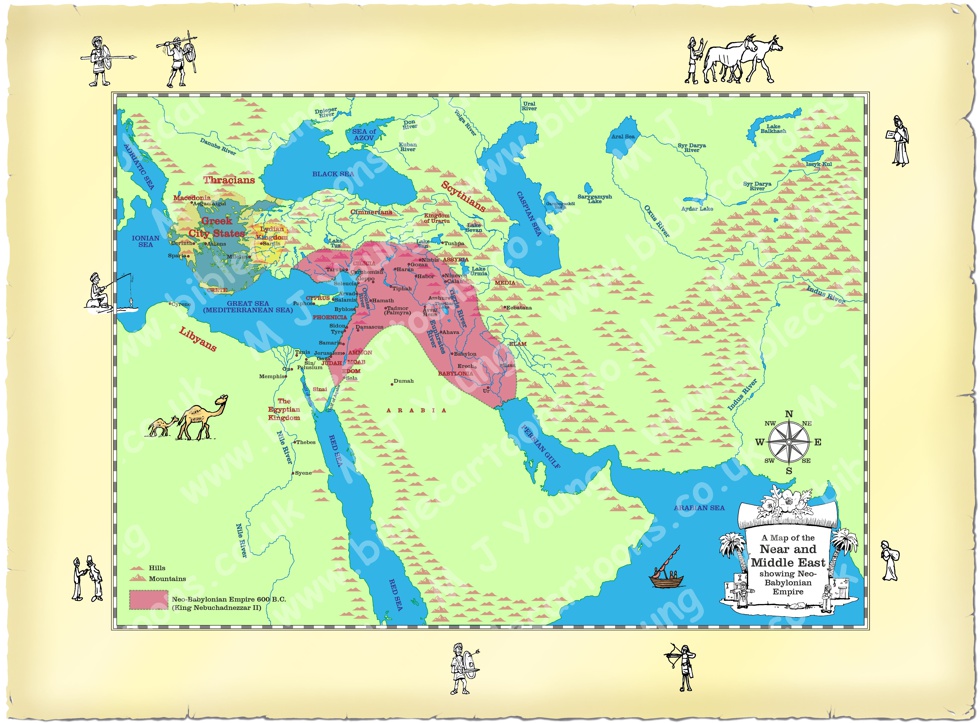
Bible Book: 2 Kings
Bible Book Code: 1202400101a
Bible Reference & Map Description
This map shows the extend of the Neo-Babylonian empire around 600 B.C.
Notice the figures on the border of the map.
If you look carefully at the map border you will see I have included some new little black and white figures, drawn specifically for this map!
The Neo-Babylonian Empire
The entire Neo-Babylonian Empire lasted from 626 B.C. to 539 B.C., but its peak of power, wealth, and architectural splendour is defined by several key milestones:Reign of Nebuchadnezzar II (605-562 B.C.):
The era of maximum territorial expansion, economic prosperity, and military dominance across the Near East.Rebuilding of Babylon (600 B.C.):
The period when the capital was transformed into an urban masterpiece, featuring monumental structures like the Ishtar Gate and massive fortification walls.Fall to Persia (539 B.C.):
The empire reached its abrupt end when Cyrus the Great conquered Babylon, bringing down the last native Mesopotamian dynasty.Peak of the Neo-Babylonian Empire.
The Babylonian Empire reached its peak during the Neo-Babylonian period (aka the Chaldean Empire) under King Nebuchadnezzar II from 605 to 562 B.C. Spanning roughly 500,000 square miles, the empire governed the entire Fertile Crescent, stretching from the Persian Gulf across modern-day Iraq, Syria, and into parts of Israel and TurkeyPeak Era and Timeline
Golden Age: Neo-Babylonian Empire (626–539 B.C).Zenith Ruler: King Nebuchadnezzar II (605–562 B.C).
Territory: Controlled Mesopotamia, the Levant, and parts of Arabia.
The year 626 B.C. marks the official founding of the Neo-Babylonian Empire (also called the Chaldean Empire). This took place when Nabopolassar revolted against the Neo-Assyrian Empire and was crowned King of Babylon, completely changing the balance of power in the ancient Middle East.
Key Events and Context
Assyrian Power Vacuum: Following the death of the powerful Assyrian king Ashurbanipal around 627 B.C., the Assyrian grip on Mesopotamia began to weaken.Nabopolassar’s Revolt: In 626 B.C., the Babylonian leader Nabopolassar successfully expelled Assyrian garrisons from key cities like Uruk and seized the throne of Babylon.
Shift in Regional Hegemony: This rebellion initiated a 20-year military campaign that ultimately destroyed the Assyrian Empire through a joint alliance with the Medes, setting the stage for Babylonian dominance in the Levant and Mesopotamia.
The golden age of the Neo-Babylonian Empire (626–539 B.C.)
The golden age of the Neo-Babylonian Empire (626–539 B.C.) occurred during the 6th century B.C.. under King [Nebuchadnezzar II] (604–562 B.C). This era transformed Babylon into the largest, most splendid city of the ancient world, famous for monumental architecture, economic prosperity, and a cultural renaissance, before falling to the Persians.Rise and Expansion
Independence: Founded in 626 B.C when Nabopolassar freed Babylon from Assyrian rule.Conquests: Nabopolassar and [Nebuchadnezzar II] defeated the Assyrian Empire and expanded control across the Fertile Crescent.
Judah Campaign: Nebuchadnezzar II sacked Jerusalem in 587 B.C., bringing many captives to Babylon.
The peak geographical extent of the Neo-Babylonian Empire.
At its peak during the Neo-Babylonian Empire under King Nebuchadnezzar II (c. 580 B.C.), the empire spanned from the Persian Gulf across Mesopotamia and the Fertile Crescent to the borders of Egypt and the Mediterranean Sea.Geographical Reach at its Peak
Northern Boundary: Reached into Carchemish and parts of Cilicia (modern-day southern Turkey).Western Boundary: Bounded by the Mediterranean coastline, including Phoenician city-states and extending toward the frontiers of Egypt.
Eastern & Southern Boundaries: Extended across the Tigris river plains toward the Zagros Mountains (Media/Persia) and south into parts of northern Arabia.
Core Capital: Centered on the lower Euphrates river in southern Mesopotamia, located near modern-day Hillah, Iraq.
The fall of the Neo-Babylonian Empire (539 B.C.)
The Neo-Babylonian Empire fell to the Persian Achaemenid Empire on October 12, 539 B.C., when forces led by Cyrus the Great captured the city of Babylon. This event ended the last native Mesopotamian ruling dynasty.Key Events of the Fall
Battle of Opis: Fought in September 539 B.C., where Persian troops defeated the Babylonian army.Fall of Babylon: Cyrus’s forces entered the capital city without major resistance on October 12, 539 B.C.
Shift in Power: King Nabonidus was deposed, and the region was absorbed into the expanding Persian Empire.
Timeline in relation to events in Israel around 600 B.C.
The northern Kingdom of Israel had already fallen and ceased to exist by 671 B.C. so there was no king reigning there at this time.
Who ruled in Judah (the divided kingdom) during 600 B.C.?
In the exact year 600 B.C., Jehoiakim (name changed from Eliakim by Pharaoh Neco) was the King of Judah. He ruled as a vassal, first to Egypt and later to Nebuchadnezzar II of Babylon, during a turbulent period that led up to the final siege and collapse of Jerusalem.Historical context: the kings of Judah around 600 B.C.
The turn of the 6th century B.C. saw rapid shifts in royal succession as the Kingdom of Judah was caught between warring empires:Josiah (Ruled 640–609 BC): The reformer king, killed in battle against Egypt.
Jehoahaz (Ruled 609 B.C.): Son of Josiah, reigned for only 3 months before being deposed by Egypt.
Eliakim/Jehoiakim (Ruled 609–598 B.C.): Placed on the throne by Egypt; he was the active king during 600 B.C.
Jehoiachin (Ruled 598–597 B.C.): Son of Jehoiakim, ruled for 3 months before surrendering to Babylon.
Zedekiah (Ruled 597–586 B.C.): The final King of Judah installed by Babylon before Jerusalem was destroyed.